Translate

Tuesday, 10 August 2021

Jennifer Hudson looks like royalty in all-purple at the ‘Respect’ movie premiere


Jennifer Hudson is gearing up for her big debut as Aretha Franklin in the upcoming biopic about the late singer’s life, Respect, a role she was handpicked specifically by Franklin to play. The film, which comes out this Friday, held its big red carpet premiere tonight at the Regency Village and Bruin Theatre in Los Angeles, where of course J.Hud looked like royalty and stole the show.


Styled by @waymanandmicah, the singer and actress wore a gorgeous custom, purple Dolce And Gabbana gown with a long train that followed the superstar everywhere she turned. The dress was sparkly, strapless, and featured a high slit allowing the 39-year-old to show off her toned legs. She wore her hair parted over to one slide and slicked back into what looked like a low bun. She added a long, purple veil to the back of her ‘do that matched the dress perfectly and had her looking like a true queen. She wore minimal jewelry except for simple earrings and silver rings on her fingers. And on her feet, she wore sparkling closed-toe pumps that helped accentuate her gorgeous frame.

“This is prob her best look ever!” one fan said of the ensemble while another fan commented, “love everything about this look on Jennifer

Jennifer’s Respect co-star and fellow actor Marlon Wayans was also in attendance of the big premiere, and the two flicked it up together outside of the event. Wayans plays Ted White in the film, Aretha Franklin’s first husband and former manager.

Attending the big red-carpet premiere isn’t the only way Hudson is preparing for her big debut as the legendary soul singer. Just last week, she released her version of Aretha’s sultry classic, “Ain’t No Way,” a single that is one of 17 tracks by Franklin that Hudson has recreated in the film and in the movie’s soundtrack.

………………………………………………………

Everyday activities in France now require proof of Covid-19 status


Starting Monday across France, everyday activities such as going to a cafe or taking a train will only be allowed for those who can show they are vaccinated, have recovered or tested negative for the coronavirus as controversial measures enter effect.


The stricter rules, which also make it compulsory for all health care workers to be vaccinated by September 15, will be in effect until mid-November and will apply to everyone who is older than 18.

Teens ages 12 to 17 will have to show such proof from September 30.

Restaurants, long-distance buses, planes, trade fairs and health facilities are among the places where such proof must now be presented; a digital health passport has already been required to go to the cinema, visit a museum or attend a major event since mid-July.

However, as Health Minister Olivier Veran pointed out to Le Parisien newspaper on Sunday, some of the rules won’t be as tough as originally planned, such as allowing a negative test to remain valid for up to 72 hours, instead of 48. Self-tests are also OK, provided they are carried out under a medical professional’s supervision.

The latest weekend demonstration against the measures attracted over 200,000 people. Mass protests have taken place every weekend since President Emmanuel Macron announced the changes in mid-July in efforts to stop the rising number of new coronavirus infections.

Among France’s 67 million residents, about 63 per cent have received at least coronavirus jab. More than half are fully vaccinated.
GNA
……………………………………………………

Hundreds of residents, tourists in Italy evacuated due to wildfires


Rome, Aug. 9, (dpa/GNA) – Italian emergency crews ordered hundreds of residents and tourists to leave their residences as wildfires approached Campomarino, on the Adriatic coast, on Sunday evening.

Global African Family Meeting
Officials evacuated more than 400 people from their homes, hotels and campsites in the seaside district, according to the fire brigade.

The emergency service shared a video on social media that showed flames approaching a cafe and thick clouds of smoke drifting through the streets. Photos also showed fires consuming people’s homes.

A firefighting plane and a helicopter were deployed to aid firefighters working to douse the flames on the ground.

No casualties were reported, according to the fire brigade.
Devastating forest fires have been raging for days in southern Italy and on the large islands of Sicily and Sardinia.

Heat, drought and winds are causing the flames to spread rapidly. Arson is suspected behind many of the fires.

Meanwhile the country is bracing for a heatwave in the coming days that could increase the danger of even more wildfires breaking out, as emergency crews continued to battle blazes across the south.

“The temperatures that await us in the coming days require the utmost attention,” civil protection agency chief Fabrizio Curcio said on Sunday.

It is crucial to avoid any behaviour that causes fires and to report fires in time, even if they are small, Curcio told the public.

He described efforts throughout the south to contain numerous wildfires as “challenging” and “dramatic.”

In Sicily and Sardinia, temperatures could soar to 45 degrees Celsius on Tuesday and Wednesday, the agency said.
On the mainland, firefighters have also battled wildfires in the southern regions of Calabria and Apulia.

The civil protection agency sent reinforcements to Calabria on Sunday after a decree issued by Italian Prime Minister Mario Draghi allowed the agency to dispatch units and volunteers.
Officials in the Lazio, Campania, Molise, Umbria, Abruzzo and Basilicata regions likewise called for additional firefighting support.
Earlier on Sunday, new fires broke out near the town of San Mauro Castelverde in the province around Palermo, the Ansa news agency reported.

Firefighters have also spent the past day trying to bring a wildfire close to the town of Cesane, near the Adriatic coast, under control.
The Coldiretti agricultural association warned about the damage to agriculture caused by the ongoing drought, especially in the south.

Wheat harvests could fall by 10 per cent, while experts expect yields of cherries, peaches and nectarines to drop by up to 50 per cent, compared with an ordinary year.
Coldiretti suspects the effects of climate change are behind the weather events.

Nature reserves, such as the Aspromonte National Park in Calabria, southern Italy, and the Parco delle Madonie, east of the Sicilian capital, Palermo, meanwhile, faced incalculable damage.

Firefighting aircraft were deployed on Sunday to battle wildfires in the Madonie nature reserve, Ansa reported.

“Once again, protected natural areas are in the grip of devastating fires,” said Giampiero Sammuri, president of the Italian Federation of Parks and Nature Reserves (Federparchi).

He called for better monitoring and protection systems in a statement on Saturday.

Near the small town of San Lorenzo, at the edge of the Aspromonte National Park, a man and a woman died in connection with the fires when blazes reached their farm, the fire brigade said on Friday.

Thousands of hectares of forest, pastures, livestock and olive groves have already burnt down. The lack of rain and the drought also favoured the spread of the flames and the actions of arsonists.
On Sunday evening, firefighters said they had brought 12 fires under control.

They have registered 44,500 forest fires since June 15, according to official data, the most seen in this period since 2017. Last year, there were just under 26,200 wildfires during the same period.
Meanwhile in northern Italy, concerns were growing that heavy rainfall could lead to flooding and landslides.

A car and a vehicle were smashed by a landslide in South Tyrol, but no injuries were reported.
But rising water levels were flooding garages and paths.
The weather service had warned of heavy rains: The northern part of the province reported downpours of 87 litres within a day.
GNA
…………………………………………………

Mobile roaming charges in Europe: What you need to know


The mobile operator Vodafone is following EE’s lead by introducing extra charges for some of its customers using their phones in Europe from next year, after the UK left the EU.

Since 2017, UK consumers have, within reason, been able to use the minutes, texts and data included on their mobile phone tariffs when travelling in the EU.

But since January 2021, UK operators have been allowed to reintroduce so-called roaming charges because the UK’s BTD deals with the EU, signed at the end of 2020, did not rule them out.

What charges will there be?

From January 2022, EE will charge customers who joined or upgraded their contracts after 7 July, £2 a day to use their tariff allowances in 47 European destinations. Customers will not be charged to use their phones in the Republic of Ireland.

There will also be 30-day packages available for people travelling for longer periods.

EE said the charges would “support investment into our UK-based customer service and leading UK network”.

Vodafone is also introducing charges for some of its new or upgrading customers, which will be applied from 6 January.

The operator will then have three types of tariffs:

  • Its cheapest sim-only deals do not allow any use apart from emergency calls outside the UK and Ireland
  • Some of its more expensive Xtra plans will include roaming at no extra charge
  • The rest of its tariffs will offer roaming for £2 a day. Eight-day and 15-day passes will be available for £1 a day.

Will other networks be charging?

All four of the big operators previously said they had no plans to introduce roaming charges. Three and O2 still say that.

But there are “fair use limits” on the amount of time that customers will be allowed to use their phones abroad.

You could not, for example, get a mobile phone contract from Greece and then use it all year round in the UK.

UK customers have been told that their operators will charge extra if they spend more than half their time overseas, generally measured by being in another country for more than 62 days in a four-month period.

That could have happened while the UK was still part of the EU, but some operators have only just started enforcing it.

Similarly, data limits are also subject to fair use restrictions. Customers of O2 have a monthly data limit of 25GB and will be charged £3.50 for each GB after that. Vodafone’s limit is also 25GB with a £3.13 charge per GB after that.

Three has cut its fair use limit from 20GB a month to 12GB and will charge £3 per GB above that.

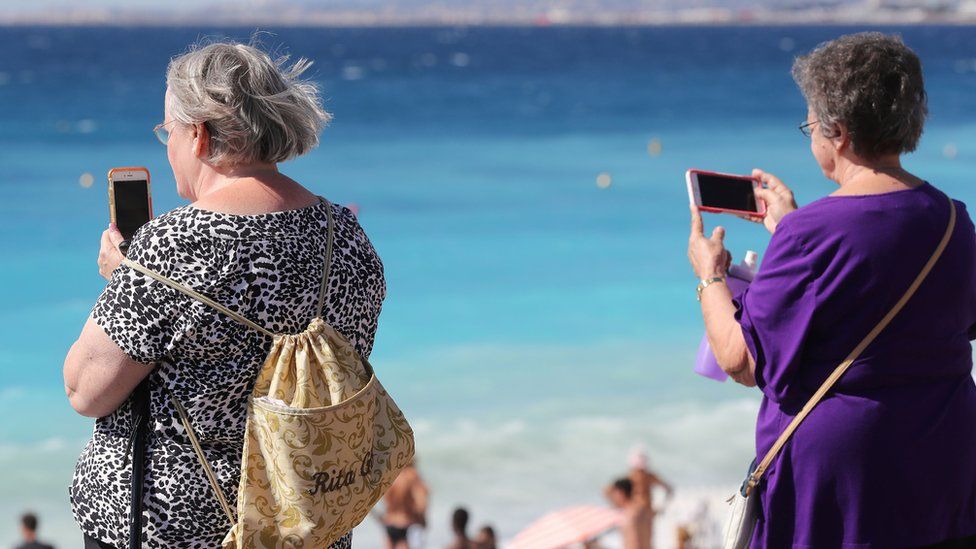
Two women using their mobile phones in France

The planned £2-a-day fees are still relatively small compared with the costs customers had to pay before the EU banned roaming charges.

In the past some people returned from European trips to face bills for hundreds or even thousands of pounds.

Are there any limits to what can be charged?

The UK trade deals with the EU said that both sides would encourage operators to have “transparent and reasonable rates” for roaming.

The UK government also passed legislation to provide some safeguards for consumers:

  • A £45-a-month limit on the amount they could be charged for using mobile data abroad before having to opt into further use
  • Requirements for customers to be informed when they have reached 80% and 100% of their data allowance
  • Operators also have to take “reasonable steps” to avoid customers being charged for accidental roaming in Northern Ireland, which could happen if a phone there locked on to a mobile signal coming from the Republic of Ireland

Will other companies end up charging customers more?

It’s not clear.

Without the EU rules in place, the charges levied depend on agreements between UK operators and their counterparts in EU countries.

While these agreements may mean costs haven’t increased so far, there’s no guarantee that they won’t do so at a later date.

However, there is a reasonable chance that some UK operators may choose to keep offering inclusive roaming:

  • Some UK operators are already part of companies that also operate in other EU countries
  • Individual companies can make reciprocal deals. For example, a UK and French operator could agree to offer each other’s customers inclusive roaming while in the other country
  • Each EU country has more than one operator, so UK operators have a choice of companies with which to deal

The four main operators in the UK declined to comment on the commercial deals they have with other operators.

…………………………………………………………

Monday, 9 August 2021

U.S. now averaging 100,000 new COVID-19 infections daily, again


NEW ROCHELLE, NY - MARCH 18: Coronavirus crisis volunteer Rhiannon Navin greets local residents arriving to a food distribution center at the WestCop community center on March 18, 2020 in New Rochelle, New York. New Rochelle has been a hot spot for the COVID-19 pandemic in the U.S. (Photo by John Moore/Getty Images)

The U.S. is now averaging 100,000 new COVID-19 infections a day, returning to a milestone last seen during the winter surge in yet another bleak reminder of how quickly the delta variant has spread through the country.

The U.S. was averaging about 11,000 cases a day in late June. Now the number is 107,143.

It took the U.S. about nine months to cross the 100,000 average case number in November before peaking at about 250,000 in early January. Cases bottomed out in June but took about six weeks to go back above 100,000, despite a vaccine that has been given to more than 70% of the adult population.

The seven-day average for daily new deaths also increased, according to data from Johns Hopkins University. It rose over the past two weeks from about 270 deaths per day to nearly 500 a day as of Friday.

The virus is spreading quickly through unvaccinated populations, especially in the South where hospitals have been overrun with patients.

Health officials are fearful that cases will continue to soar if more Americans don’t embrace the vaccine.

“Our models show that if we don’t (vaccinate people), we could be up to several hundred thousand cases a day, similar to our surge in early January,” Centers for Disease Control and Prevention director Rochelle Walensky said on CNN this week.

The number of Americans hospitalized with the virus has also skyrocketed and it has gotten so bad that many hospitals are scrambling to find beds for patients in far-off locations.

Houston officials say the latest wave of COVID-19 cases is pushing the local health care system to nearly “a breaking point,” resulting in some patients having to be transferred out of the city to get medical care, including one who had to be taken to North Dakota.

Dr. David Persse, who is health authority for the Houston Health Department and EMS medical director, said some ambulances were waiting hours to offload patients at Houston area hospitals because no beds were available. Persse said he feared this would lead to prolonged respond times to 911 medical calls.

“The health care system right now is nearly at a breaking point … For the next three weeks or so, I see no relief on what’s happening in emergency departments,” Persse said Thursday.

Last weekend, a patient in Houston had to be transferred to North Dakota to get medical care. An 11-month-old girl with COVID-19 and who was having seizures had to be transported on Thursday from Houston to a hospital 170 miles (274 kilometers) away in Temple.

In Missouri, 30 ambulances and more than 60 medical personnel will be stationed across the state to help transport COVID-19 patients to other regions if nearby hospitals are too full to admit them, Missouri Gov. Mike Parson announced Friday.

…………………………………………………………

Afghanistan war: Taliban push on while rejecting truce


The Taliban have rejected international calls for a ceasefire in Afghanistan, as they push for new territory.

They are reported to have overrun the key northern city of Kunduz, as well as Sar-e-Pul and Taloqan. Fierce fighting continues in two more northern cities.

Five regional capitals have fallen to the militants since Friday, with Kunduz their most important gain this year.

US and Afghan planes have carried out airstrikes on the militants. Afghan officials say dozens of Taliban died.

However, a spokesman for the Taliban warned against further US intervention while speaking to Al Jazeera TV on Sunday.

Violence has escalated across Afghanistan after US and other international forces began to withdraw their troops from the country, following 20 years of military operations.

Taliban militants have made rapid advances in recent weeks. Having captured large swathes of the countryside, they are now targeting key towns and cities.

The three northern cities fell to Taliban control within hours of each other on Sunday, with one resident in Kunduz describing the situation as “total chaos”.

Videos posted on social media showed Taliban fighters inside government buildings in Kunduz and Sar-e-Pul, though they cannot be independently verified.

The Afghan government, meanwhile, said special forces were still fighting inside Kunduz.

A Taliban spokesman told the BBC they were now targeting Pul-e-Khumri, the capital of Baghlan province.

Heavy fighting has been reported in the city, as well as in Mazar-e-Sharif, a trading hub on the border with Uzbekistan.

On Monday morning a loud explosion was heard outside the police headquarters in the southern city of Lashkar Gah.

Residents there said about 20 civilians had been killed in the past two days, and a school and a clinic destroyed in the fighting.

The seizure of Kunduz is the most significant gain for the Taliban since they launched their offensive in May. The city of 270,000 people is considered a gateway to the country’s mineral-rich northern provinces.

And its location makes it strategically important as there are highways connecting Kunduz to other major cities, including Kabul, and the province shares a border with Tajikistan

That border is used for the smuggling of Afghan opium and heroin to Central Asia, which then finds its way to Europe. Controlling Kunduz means controlling one of the most important drug smuggling routes in the region.

It also holds symbolic significance for the Taliban because it was a key northern stronghold before 2001. The militants captured the city in 2015 and again in 2016 but have never been able to hold it for long.

………………………………………………………

Across Africa in five minutes or less


AFRICA

From Tunisia to South Africa, the pandemic has reopened or exposed existing economic and political challenges. Failures to tackle unemployment, debt, rising poverty and inequalities are leading to social unrest, with no end to the health crisis in sight. As the third wave takes a grip across Africa, the International Monetary Fund (IMF) has warned the gap between rich and poor nations is widening.

NIGERIA

The National Assembly is carrying out its fifth amendment to Nigeria’s 1999 Constitution The National Assembly is currently amending the 1999 constitution. This would be the fifth alteration to the main Nigerian law. Lawmakers in both the Senate and the House of Representatives committees on constitution review had in May and June organised public hearings across the country’s six geopolitical zones, as part of the amendment process. Many agencies, institutions, groups and individuals submitted memoranda and appeared before the panel to make or defend their submissions.

SOUTH SUDAN

Attempts to ignite a popular uprising by civil society groups in South Sudan was off to a rocky start. Calling itself the People’s Coalition for Civil Action (PCCA), the group launched a public campaign dubbed “We have had enough” in Juba on July 31 for political change, claiming that the ruling Sudan Peoples’ Liberation Movement (SPLM) has failed after 10 years of independence. The civil society is seeking public pressure to oust SPLM regime like their counterpart did in Sudan, bringing an end to Omar al Bashir leadership.

KENYA

Twice in three months, some junior police officers in Murang’a South have written a protest letter to the regional commissioner alleging harassment by the area’s Directorate of Criminal Investigations officer (DCIO). They allege that David Cheruiyott threatens to investigate them if they refuse to help him advance his interests. The letter claims Mr Cheruiyott’s interests are in liquor businesses and political formations. In one instance, Mr Cheruiyott is accused of leaking real estate-related investigations to Maragua MP Mary Wa Maua, insider information that was used during an incident on Tuesday at Kaharate.

TANZANIA

Maize imports from Tanzania jumped more than sixfold to 118,329 bags in May on the back of President Samia Suluhu’s visit to Kenya that saw Dar and Nairobi reach a deal to lift a ban that had been put in place. Kenya’s Agriculture ministry says the volumes jumped from 16,137 bags in April to a monthly record of 118,329 in May after President Samia and her Kenyan counterpart Uhuru Kenyatta reached a bilateral deal to abolish the restrictions that Nairobi had imposed on Tanzanian maize.

UGANDA

The parliamentary taskforce on Covid-19 response has faulted the National Medical Stores (NMS), and the Health ministry on ignoring the plight of frontline medical workers across the country. The MPs in the report released to Parliament on Tuesday, said the two institutions had failed to supply medics with enough personal protective equipment (PPEs) against Covid-19. In their countrywide fact-finding report, the MPs also said essential medicines for treating Covid-19 patients were in short supplies in many health units, and that patients had been forced to buy them from private facilities.

ZIMBABWE

Ahead of the country’s Heroes Day, President Mnangagwa has honoured outstanding Zimbabweans who have raised the country’s flag high in various fields. In a Government Gazzette, the Chief Secretary to the President and Cabinet Dr Misheck Sibanda announced that outstanding Zimbabweans will be honoured under the new set of awards that were introduced by the Second Republic. Previously, only members of the uniformed forces could be conferred with such national awards and honours but in yet another first, the New Dispensation has extended the honour to civilians.

………………………………………………………

When Telecommunications Collapse: What Angola's Mobile Network Crisis Teaches Us About Governance, Justice, and National Security

  The recent disruption of Angola's mobile networks has affected banking, digital payments, businesses, emergency communications, and mi...