The TFF Challenge 2021 is in full swing – only 7 days until the pitch deadline of May 28th!
There has never been a more exciting or important time to join the Thought For Food movement. Help us spread the word to anyone you know who has a startup, an idea, or an interest in building innovative solutions! The TFF Challenge is the place to be.
The TFF Challenge is the world’s largest and most diverse agri-food-tech innovation challenge open to purpose-driven innovators at all stages (ideation through to an incorporated startup). This is our call to action to seek all kinds of solutions to address the prevailing question:
“How do we feed 10bn people on a hotter planet?”
To kick off the TFF Challenge 2021, we will run a 48-hour virtual global hackathon called the “BrainRave”. The event will unite you, our community, and other creative change-makers to connect, learn, collaborate, and develop real ideas and solutions for improved food systems and climate action: entrepreneurs, designers, coders, investors, media, artists, activists, and more. You will co-create deep insights and creative solutions leading up to the UN Food Systems Summit and COP-26: “how to feed 10bn people on a hotter planet?”
GAZA CITY, Gaza Strip (AP) — Palestinians rallied by the thousands early Friday after a cease-fire took effect in the latest Gaza war, with many viewing it as costly but clear victory for the Islamic militant group Hamas over a far more powerful Israel.
The 11-day war left more than 200 dead — the vast majority Palestinians — and brought widespread devastation to the already impoverished Hamas-ruled Gaza Strip. But the rocket barrages that brought life to a standstill in much of Israel were seen by many Palestinians as a bold response to perceived Israeli abuses in Jerusalem, the emotional heart of the conflict.
The truce faces an early test on Friday, when tens of thousands of Palestinians attend weekly prayers at the Al-Aqsa Mosque compound in Jerusalem, a flashpoint holy site revered by Jews and Muslims. Celebratory protests could spark confrontations with Israeli police, setting in motion another cycle of escalation like the one that led to the war.
Thousands took to the streets of Gaza as the cease-fire took hold at 2 a.m. Young men waved Palestinian and Hamas flags, passed out sweets, honked horns and set off fireworks. Spontaneous celebrations also broke out in east Jerusalem and across the occupied West Bank.
An open-air market in Gaza City that was closed throughout the war reopened and shoppers could be seen stocking up on fresh tomatoes, cabbage and watermelons. Workers in orange traffic vests swept up rubble from the surrounding roads.
“Life will return, because this is not the first war, and it will not be the last war,” said shop owner Ashraf Abu Mohammad. “The heart is in pain, there have been disasters, families wiped from the civil registry, and this saddens us. But this is our fate in this land, to remain patient.”
The mood was more somber in Israel, where Prime Minister Benjamin Netanyahu faced angry accusations from his right-wing base that he had halted the war too soon.
Like the three previous wars between the bitter enemies, the latest round of fighting ended inconclusively. Israel claimed to have inflicted heavy damage on Hamas with hundreds of bruising airstrikes but once again was unable to halt the rockets.
Hamas also claimed victory, despite the horrifying toll the war took on countless Palestinian families who lost loved ones, homes and businesses. It now faces the daunting challenge of rebuilding in a territory already suffering from high unemployment and a coronavirus outbreak.
The cease-fire was brokered by neighboring Egypt after the U.S. pressed Israel to wind down the offensive. Netanyahu announced that Israel had accepted the proposal late Thursday, while emphasizing that “the reality on the ground will determine the future of the campaign.”
U.S. Secretary of State Antony Blinken plans to visit the region in the coming days “to discuss recovery efforts and working together to build better futures for Israelis and Palestinians.” the State Department said.
The fighting began on May 10, when Hamas militants in Gaza fired long-range rockets toward Jerusalem. The barrage came after days of clashes between Palestinian protesters and Israeli police at Al-Aqsa. Heavy-handed police tactics at the compound, and the threatened eviction of dozens of Palestinian families by Jewish settlers had inflamed tensions.
The competing claims to Jerusalem lie at the heart of the Israeli-Palestinian conflict and have repeatedly triggered bouts of violence in the past.
Hamas and other militant groups fired over 4,000 rockets at Israel throughout the fighting, launching the projectiles from civilian areas at Israeli cities. Dozens of projectiles flew as far north as Tel Aviv, the country’s bustling commercial capital.
Thousands gathered Friday morning in the southern Gaza Strip town of Khan Younis outside the family house of Mohammed Deif, the shadowy Hamas commander who had ordered the rocket attacks. Supporters shouted “victory” and waved green Hamas flags.
Israel, meanwhile, carried out hundreds of airstrikes targeting what it said was Hamas’ military infrastructure, including a vast tunnel network.
At least 230 Palestinians were killed, including 65 children and 39 women, with 1,710 people wounded, according to the Gaza Health Ministry, which does not break the numbers down into fighters and civilians. Twelve people in Israel, including a 5-year-old boy and 16-year-old girl, were killed.
The United States, Israel’s closest and most important ally, initially backed what it said was Israel’s right to self-defense against indiscriminate rocket fire. But as the fighting dragged on and the death toll mounted, the Americans increasingly pressured Israel to stop the offensive.
In a rare public rift, Netanyahu on Wednesday briefly rebuffed a public call from President Joe Biden to wind things down, appearing determined to inflict maximum damage on Hamas in a war that could help save his political career.
But late Thursday, Netanyahu’s office announced the cease-fire agreement. Hamas quickly followed suit. Militants continued to launch sporadic rocket at Israel early Friday, before the 2 a.m. cease-fire took effect.
In Washington, Biden hailed the cease-fire. “I believe we have a genuine opportunity to make progress, and I’m committed to working for it,” he said.
Biden said the U.S. was committed to helping Israel replenish its supply of interceptor missiles for its Iron Dome rocket-defense system and to working with the internationally recognized Palestinian Authority — not Hamas — to provide humanitarian aid to Gaza.
Netanyahu quickly came under heavy criticism from members of his hawkish, nationalist base. Gideon Saar, a former ally who now leads a small party opposed to the prime minister, called the cease-fire “embarrassing.” Itamar Ben Gvir, head of the far-right Jewish Power party, tweeted that the cease-fire was “a grave surrender to terrorism and the dictates of Hamas.”
In a potentially damaging development for the Israeli leader, the Palestinian militants claimed Netanyahu had agreed to halt further Israeli actions at the Al Aqsa Mosque and to call off the planned evictions of Palestinians in the nearby Sheikh Jarrah neighborhood.
An Egyptian official said only that tensions in Jerusalem “will be addressed.” He spoke on condition of anonymity because he was discussing behind-the-scenes negotiations and provided no details.
Hamas and the smaller Islamic Jihad militant group declared victory, but both appear to have suffered significant losses. The two groups said at least 20 of their fighters were killed, while Israel said the number was at least 130 and probably higher.
Some 58,000 Palestinians sought shelter in crowded United Nations schools at a time of a coronavirus outbreak. They began returning to their homes as the truce took hold.
Since the fighting began, Gaza’s infrastructure, already weakened by a 14-year blockade, has rapidly deteriorated, and airstrikes have damaged schools and health centers.
Medical supplies, water and fuel for electricity are running low in the territory, on which Israel and Egypt imposed the blockade after Hamas seized power from the Palestinian Authority in 2007. Since then, Palestinian President Mahmoud Abbas has governed autonomous areas of the Israeli-occupied West Bank and has limited influence in Gaza.
Several African countries lack AstraZeneca vaccines to administer second doses after India bans exports due to crisis.
Africa’s vaccination campaigns to battle COVID-19 are facing significant delays because of the export ban imposed by India as it grapples with a devastating resurgence of the disease, Africa’s top health official has said.
The AstraZeneca vaccine manufactured by the Serum Institute of India was to be an integral part of the United Nations-backed COVAX initiative to distribute vaccines to low- and middle-income nations.
India’s deadly crisis and its decision to halt all exports of the vaccines it produces had badly affected Africa’s mass vaccination drive, which was already lagging behind many other parts of the world, John Nkengasong, director of the Africa Centers for Disease Control and Prevention, said on Thursday.
Several African countries had administered all the AstraZeneca vaccines they received, expecting new deliveries in order to give people their second dose, said Nkengasong, in his weekly news briefing.
But as a result of India’s ban on exports, those countries do not have AstraZeneca vaccines to give people their second doses.
“There is a likelihood that, given what is going on in India, there will be a significant delay,” said Nkengasong, who suggested using other vaccines.
“Countries should be looking at options of how to get the Johnson & Johnson vaccines that are available through the African Union’s vaccine acquisition task team as an alternative, which is a single-dose vaccine,” he said.
The continent has more than 4.7 million confirmed cases of infections including 127, 000 deaths recorded since the virus outbreak, which accounts for 3 percent of global infections and 4 percent of global deaths, said Nkengasong.
South Africa, Morocco, Tunisia, Ethiopia, and Egypt together account for about 60 percent of all infections recorded in the continent.
A little more than 56,000 cases have been recorded in the last week, a 6 percent decrease of new infections compared with the previous week, he said.
Nkengasong said nine African countries have detected the variant that is now dominant in India.
“The way this virus circulates and transmits suggests that it is a question of time before this variant will be spreading more extensively across the continent,” said Nkengasong.
Record numbers of infections and deaths sweep Nepal, prompting fears its second wave may be worse than India’s.
The Sukraraj Tropical and Infectious Disease Hospital in the Nepali capital, Kathmandu, is packed – so packed that in some cases two patients share one bed – as a second COVID-19 wave overwhelms the country’s health infrastructure.
Health experts and front-line medical workers have described the situation as “near-apocalyptic” as they face shortages of hospital beds and oxygen, the national vaccination campaign grinds almost to a halt and the numbers of dead are so high that mass cremations are being held.
“We have been treating patients in every corner of the hospital premises. We are even using the garage to admit as many patients as possible,” said Beli Poudel, a nurse at Sukraraj.
“We do not turn any patient away, we try to accommodate them despite our limited capacity,” Poudel told Al Jazeera, adding that more than 120 COVID-19 patients are being treated in the 104-bed hospital, which has only 24 ICU beds. The hospital, experiencing a huge influx of severely affected patients in the pandemic’s second wave, had already doubled its capacity.
For several weeks now, many of the staff at Sukraraj – the only facility in Nepal specialising in tropical and infectious diseases – have lived in hostels or on hospital premises away from their families.
With just over 21,000 tests on May 19, Nepal logged 8,173 COVID cases and 246 deaths, the highest number recorded since the pandemic broke out last year. Health experts believe the real numbers could be much higher as testing remains low. More than 5,600 people have died since the pandemic began, nearly 2,000 in the past few weeks alone, according to official figures.
The pandemic has particularly affected the Kathmandu Valley and the country’s western lowland bordering the Indian state of Uttar Pradesh. The region is one of Nepal’s least developed, with a large concentration of Indigenous people and ethnic and religious minorities.
Shahbaz Ahmed, a resident of Nepalgunj in western Nepal, lost his three brothers – Zahir, Ejaz and Imtiyaz – to coronavirus in the first week of May.
From left: Imtiyaz Ahmed, Ejaz Ahmed and Zahir Ahmed [Courtesy: Shahbaz Ahmed]
All three brothers in their 40s were receiving treatment at Bheri government hospital following health complications.“The doctors couldn’t save them despite trying their best. Maybe it was Allah’s wish,” Shahbaz told Al Jazeera over the phone.
Zahir, the youngest among seven siblings, was a former member of the under-19 national cricket team. “He (Zahir) was the fittest among all brothers,” Shahbaz said.
Shahbaz, who is mourning in isolation like the rest of his family, rued the crippled health infrastructure.
“I am grateful to health workers because they are risking their lives to save others. But I think the government and politicians aren’t fulfilling their duties,” he said.
Health experts and front-line medical workers describe the situation as ‘near-apocalyptic’ [File: Prakash Mathema/AFP]
Biren Budhathoki, a resident of Dang in western Nepal, said a delayed diagnosis led to the death of his 38-year-old cousin on May 14.Most hospitals, except for the large ones in cities, do not have a machine for polymerase chain reaction (PCR) tests, crucial for timely diagnosis and avoiding preventable death.
“By the time we got the result for the PCR test, my cousin had already developed pneumonia. He passed away shortly after we shifted him to COVID-19 hospital from a local nursing home in Salyan,” said Budhathoki.
The rising number of cases in the country has set alarm bells ringing, with Prime Minister Khadga Prasad Sharma Oli and the health minister publicly admitting that hospitals were overwhelmed by patients.
Families stand outside the crematorium waiting for the bodies of their relatives, who died of COVID, to arrive, in Kathmandu [File: Navesh Chitrakar/Reuters]
“The number of infections is straining the healthcare system; it has become tough to provide patients with the hospital beds that they need,” Oli wrote in an opinion piece in the Guardian newspaper, urging the international community to assist.Experts have linked the spike in Nepal to the devastating second wave in its northern neighbour, India. Up to mid-April, deaths from COVID had been confined to single digits. At 6.51, Nepal’s daily rate of deaths per million is now the worst in South Asia.
The shortage of beds is a common problem across Nepal, which has approximately 18,900 general, 1,450 ICU and 630 ventilator beds across the country. New Delhi, India’s capital with a smaller population, has more than 4,000 ICU beds.
Anup Bastola, chief consultant at Sukraraj hospital, told Al Jazeera all the patients in the ICU were in critical condition.
“While we have 24 ICU beds, we only have 12 ventilators. All of them need ventilators but we have not been able to provide them,” he said.
Nepal’s number of doctors per capita is also one of the lowest in the world, with 0.17 doctors per 1,000 people, while India has 1.34 doctors per 1,000 population.
At least 12 ICU patients have lost their lives due to oxygen shortages since last week, according to media reports.
Pramod Paudel, a doctor at Bharatpur Hospital in central Nepal, said his hospital was admitting fewer patients than its actual capacity, accepting only 144 patients despite a capacity of 200, due to disruptions in the oxygen supply.
“Sometimes when the oxygen stocks are about to run out, we worry whether we will be able to get more for our needy patients. We cannot take more patients because of the oxygen shortages,” Paudel told Al Jazeera.
A woman holds oxygen cylinders after refiling them at a factory amid an oxygen shortage [File: Navesh Chitrakar/Reuters]
In recent weeks, medical aid, including oxygen tanks, has been trickling in from across the globe, but officials say that it is nowhere near enough to meet demand. Many Nepalese living abroad have pitched in. Nearly one-third of Nepalese work abroad.On Wednesday, the Ministry of Health and Population confirmed it had detected a third COVID variant in the country, B.1.617.2, a variant first detected in India which is considered highly contagious. The new variant was detected in 97 percent of the samples collected from 35 districts in the country. The other two variants are B.1.617.1 and B.1.1.7.
“We might be somewhere around the peak as the infection rate, by the government’s own conservative estimates, is between 40 to 50 percent,” said Basu Dev Pandey, one of Nepal’s foremost virologists and former head of the Epidemiology and Disease Control Division under Nepal’s Ministry of Health and Population.
“The severity of infection is very similar to India. Moreover, we also share a long open border where the cross-border movement remains largely unregulated. The flights between the two countries are still in operation,” said Pandey. Kathmandu has banned other international flights.
Health experts in Nepal had warned in March about the danger of a more lethal variant of the coronavirus entering via India.
The warning was not unwarranted, with Nepal sharing a porous border of nearly 1,700km (1,100 miles) with India. Millions of Nepalese work in Indian cities such as Delhi and Mumbai and many started to return in April as several Indian states imposed lockdowns in the wake of the country’s devastating second COVID wave.
Meanwhile, Prime Minister Oli has come under fire for prioritising politics over the country’s pandemic response – dissolving the parliament and dividing political opponents who were trying to remove him from office. At the same time, the prime minister continues to recommend unproven herbal medicines, going as far to say that Nepalese have better immunity to withstand the virus.
Prime Minister Oli has come under criticism for prioritising politics over the pandemic response [File: Navesh Chitrakar/Reuters]
At a function in Kathmandu last month, the prime minister claimed, albeit with a caveat, that gargling with hot water in which guava leaves had been boiled could keep COVID at bay. “Even vaccines cannot guarantee 100 percent protection,” Oli said.Gehendra Lal Malla, a professor of political science at Tribhuvan University in Kathmandu, said Oli’s unfounded remedies and light remarks on the immune system had misled people to take the virus lightly.
“It was understandable that Nepal doesn’t have good medical infrastructure like the West, or China and India, but there was ample time and money to buy ICU beds and ventilators. But Oli was more preoccupied in securing his position than saving lives,” Malla told Al Jazeera.
Although experts have called on the government to speed up vaccinations, the much-hyped immunisation drive has fallen short of expectations after the Serum Institute of India (SII) suspended the supply of AstraZeneca jabs, despite receiving payment in advance. SII – the world’s largest vaccine maker – stopped exports to prioritise India, which has seen tens of thousands of deaths in the past couple of months.
Nepal, a poor country of 30 million, has vaccinated barely two million people, mainly front-line workers, since it started inoculations on January 27. So far, the country has procured more than three million vaccines, including 800,000 doses from China and 348,000 doses from the WHO-led COVAX facility.
Defending the government’s handling of the COVID situation, former minister Mani Chandra Thapa told Al Jazeera all political parties should be blamed for focusing more on power games instead of the pandemic.
“It’s true that the government could have worked more effectively. But let’s not forget that other parties were creating hurdles by trying to oust the government in the middle of the pandemic. Therefore, all of us should take the blame and move forward to fight the virus,” Thapa said.
TOKYO (AP) — As she struggled to breathe, Shizue Akita had to wait more than six hours while paramedics searched for a hospital in Osaka that would treat her worsening COVID-19.
When she finally got to one that wasn’t overwhelmed with other patients, doctors diagnosed severe pneumonia and organ failure and sedated her. Akita, 87, was dead two weeks later.
“Osaka’s medical systems have collapsed,” said her son, Kazuyuki Akita. He has watched from his home north of Tokyo as three other family members in Osaka have dealt with the virus, and with inadequate health care. “It’s like hell.”
Hospitals in Osaka, Japan’s third-biggest city and only 2 1/2 hours by bullet train from Summer Olympics host Tokyo, are overflowing with coronavirus patients. About 35,000 people nationwide — twice the number of those in hospitals — must stay at home with the disease, often becoming seriously ill and sometimes dying before they can get medical care.
As cases surge in Osaka, medical workers say that every corner of the system has been slowed, stretched and burdened. And it’s happening in other parts of the country, too.
The frustration and fear are clear in interviews by The Associated Press with besieged medical workers and the families of patients in Osaka. It’s in striking contrast with the tone in the capital Tokyo, where Olympic organizers and government officials insist the July Games will be safe and orderly even as a state of emergency spreads to more parts of the country and a growing number of citizens call for a cancellation.
Some see Osaka as a warning for what could happen to the rest of Japan if the crisis worsens at a time when officials — and the world — are focused on the Olympics.
Osaka’s struggles are a “man-made disaster,” Akita told AP in a written message, caused in part by officials lifting an earlier state of emergency despite signs of a rebound in infections. He thinks his mother might have lived if she’d been treated sooner.
Many here are stunned by what’s happening. Japan, after all, is the world’s third-biggest economy and has, until now, managed the pandemic better than many other advanced nations. But the current surge has sent the daily tallies of the sick and dying to new highs.
The turmoil is most evident in Osaka.
Paramedics, clad in protective gear, cannot perform mouth-to-mouth resuscitation and must take extreme precautions to avoid exposure to aerosols, officials and health workers say. Disinfecting an ambulance takes an hour after it has carried a COVID-19 patient, keeping paramedics from rushing to the next call.
Emergency patients get only the treatment that happens to be available, not what’s most likely to increase their chance of survival, medical experts say.
A patient suffering from heart failure, for example, was rejected by an advanced emergency hospital, and a child in critical condition could not find a pediatric hospital because they were all full, according to an Osaka paramedic who would only give his first name, Satoshi, because he is not authorized to talk to the media. The child later died, he said.
“Our job is to bring people who are dying and deteriorating to the hospital,” he said. “In the current situation, we are not even able to do our job.”
As emergency measures drag on amid surging cases, Prime Minister Yoshihide Suga has seen support for his government slide. While he insists Japan will safely hold the Olympics, polls show 60% to 80% are against pushing ahead with the Games.
There is no indication so far the Olympics will be canceled. The International Olympic Committee, which was wrapping up its final planning sessions on Friday with Tokyo Olympic organizers, has repeatedly said they are going ahead.
But the IOC’s most senior member Richard Pound, in an interview with Japan’s JiJi Press, said that the final deadline to call it off was “before the end of June.” Pound repeated — as the IOC has said — that if the Olympics can’t happen this summer they will be canceled, not postponed again.
Japanese medical groups say they cannot accommodate the possible health needs of the Olympics as pressure for coronavirus treatment rises and medical workers and government officials try to speed up a slow-moving vaccination rollout. Less than 2% of the total population has been fully vaccinated.
As the vaccination pace gradually picks up, the government plans to open two large inoculation centers Monday using Moderna shots, one of two new vaccines expected to be approved Friday.
This week Osaka passed Tokyo, the nation’s biggest city, with the most total virus deaths, at 2,036. Of about 15,000 patients in Osaka, only about 12% landed at hospitals, while the rest had to wait at home or in hotels. The number of COVID-19 deaths that happened outside of hospitals in April tripled from March to 96, including 39 in Osaka and 10 in Tokyo, police statistics show.
Japan’s daily cases and deaths are small by global standards, and the country has one of the world’s largest per-capita numbers of hospital beds.
So why the struggles?
It is partly because unprofitable COVID-19 treatment is largely limited to public-run hospitals, which account for only about one-fifth of Japan’s 8,000 hospitals. Private hospitals, many of them small, are hesitant or unprepared to deal with coronavirus cases.
The government has also significantly reduced local health centers, which are key to infectious disease prevention, from about 850 in the 1990s to 469 in 2020, causing bottlenecks because of staff shortages and overwork.
Less than 5% of about 1.5 million hospital beds in Japan are set aside for COVID-19 treatment, an increase from less than 1,000 in April of last year, according to Health Ministry data, but still not enough.
The recent surge has seen more serious cases that have quickly filled hospital beds.
More than half of about 55 coronavirus deaths at the Osaka City Juso Hospital are from the latest surge, said Dr. Yukio Nishiguchi, head of the hospital. “It’s like being hit by a disaster,” he said.
Osaka Gov. Hirofumi Yoshimura, criticized for being too slow, said he regretted not being able to predict the faster-than-expected surge of serious cases.
While acknowledging that Osaka’s medical systems are severely strained, Yoshimura said that patients are being properly sorted by health centers and that those still at home are staying there “by consent.”
Because hospital beds for serious cases have filled up, patients with milder symptoms, but still in need of hospitalization, have to stay home or at hotels. And people who need other, non-coronavirus treatment are also suffering.
Naoki Hodo, a funeral director in southern Osaka, said that in April an emergency operator refused to send an ambulance for his 85-year-old aunt, telling the family to call back when they found a hospital themselves. His aunt had a badly swollen eye and hadn’t eaten for two days.
It took the family six hours of frantic calls to hospitals on a list given by the operator before they found one. The aunt is still hospitalized, and her doctor says she may never see again on one of her eyes.
Nishiguchi, who specializes in colorectal cancer surgery, said the pandemic has caused him to scale down or postpone operations for his cancer patients.
“Our priority is to save the lives under threat right now, and I hope people understand,” he said.
Hodo, the mortician, wears full protective gear when he goes to collect COVID-19 victims’ bodies at hospitals. The dead are placed in double waterproof body bags and then in coffins when they leave the hospital, so families cannot see their faces.
“They can’t even have a proper farewell with their loved ones,” Hodo said. “It’s heartbreaking.”
Former President John Mahama has, in a letter to the Chairperson of the African Union Commission, withdrawn his acceptance of the continental body’s appointment as its High Representative for Somalia.
While thanking the AU for the confidence reposed in him, Mr Mahama noted that, “the high political importance of the proposed assignment requires that the High Representative enjoy the unalloyed support and co-operation of all political stakeholders.”
President Mahama, whose appointment as the AU envoy has been roundly welcomed by the Council of Presidential Candidates of Somalia, and the Coalition of Somalia’s Federal Member States, further cautioned in his letter to the AU Chairperson, Moussa Faki Mahamat, that the lack of support by the Federal Government could jeopardise the whole process and undermine the hopes that the entire world has in bringing peace to the esteemed land of Somalia.
The former Ghanaian President who continues to receive requests from various international bodies and groups and is widely respected for his commitment to democratic consolidation, peacebuilding and development used the opportunity to reaffirm his commitment to the African Union’s vision of an integrated, prosperous and peaceful Africa, that includes Somalia.
Africa and Latin America have 0.17 and 2 percent respectively of global production capacity, the World Trade Organization’s head said on the eve of a global health summit in Rome, Italy.
The head of the World Trade Organization (WTO) said Thursday that it is of paramount importance to diversify vaccine manufacturing and to have more production taking place in Africa and Latin America to contain the COVID-19 pandemic.
On the eve of a global health summit in Rome, WTO Director-General Ngozi Okonjo-Iweala told European Union legislators that normal market forces for exports and imports couldn’t apply when it comes to the life-or-death issue of COVID-19 vaccines, as many of the world’s wealthiest nations were hoarding the shots for their own populations when the coronavirus crisis hit their home turf.
She said the world has the capacity to manufacture some five billion vaccine doses overall, but that as the virus has spread “we require twice and three times that. So the capacity was not there.”
One of the main challenges is diversifying vaccine production, which is now 80 percent concentrated in 10 European, North American and South Asian nations, Okonjo-Iweala said, calling the situation a problem that “has come home to roost”.
“It’s not normal that Africa, with 1.3 billion people, has 0.17 percent of the manufacturing capacity of the world,” she said. “So this has to change.” She added that Latin America has about 2 percent of global production capacity.
The summit set for Friday, co-hosted by the European Union’s executive arm and Italy, is expected to draw the Group of 20 industrial and emerging-market nations, the heads of international organisations and representatives of global health bodies.
The European Union is set to raise many of the same points Okonjo-Iweala made, specifically looking to increase manufacturing production in Africa.
EU nations have criticised a call by the US to waive COVID-19 vaccine patents as a way to increase supplies, arguing the move would yield no short-term or intermediate improvement and could even have a negative impact.
Okonjo-Iweala sought to remain neutral on the issue, but said WTO members could find flexibility to make sure more vaccines are produced in developing nations.


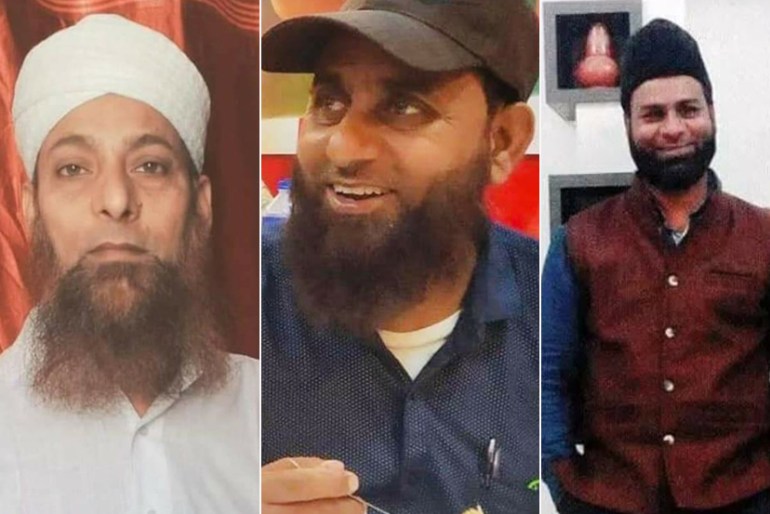 From left: Imtiyaz Ahmed, Ejaz Ahmed and Zahir Ahmed [Courtesy: Shahbaz Ahmed]
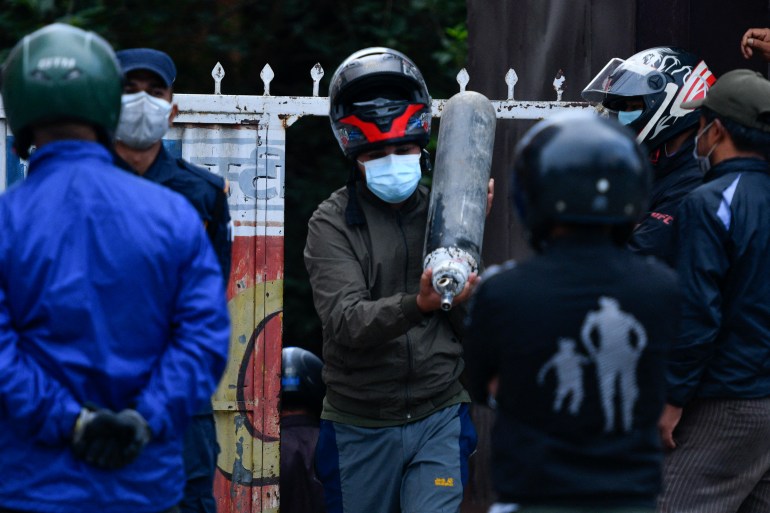 Health experts and front-line medical workers describe the situation as ‘near-apocalyptic’ [File: Prakash Mathema/AFP]
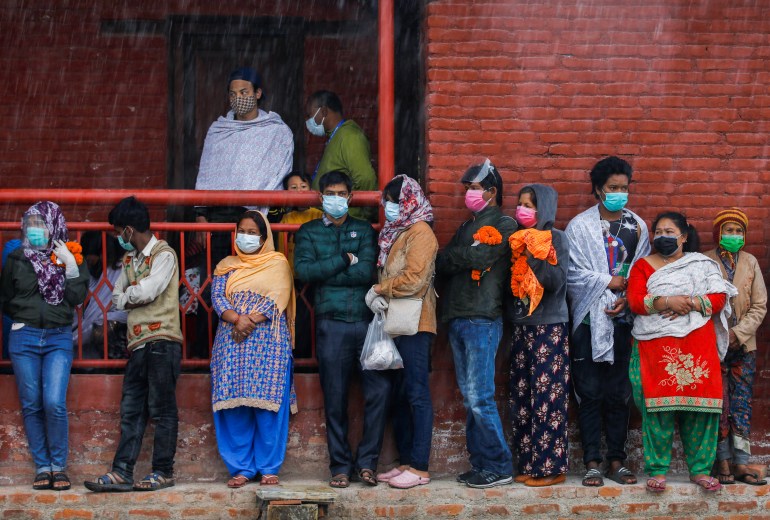 Families stand outside the crematorium waiting for the bodies of their relatives, who died of COVID, to arrive, in Kathmandu [File: Navesh Chitrakar/Reuters]
 A woman holds oxygen cylinders after refiling them at a factory amid an oxygen shortage [File: Navesh Chitrakar/Reuters]
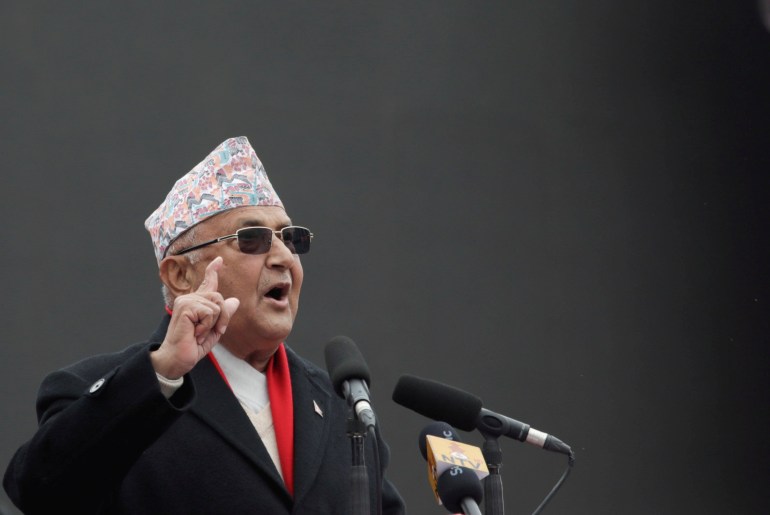 Prime Minister Oli has come under criticism for prioritising politics over the pandemic response [File: Navesh Chitrakar/Reuters]


