
 US Ambassador to Palau John Hennessey-Niland, right, attend a news conference in Taipei with Palau President Surangel Whipps, centre, Taiwan Foreign Minister Joseph Wu, left. Niland became the highest-ranking American diplomat to visit Taiwan in 42 years [File: Ann Wang/Reuters]
Similarly, the acting US ambassador in Japan in March tweeted a picture of himself meeting at his official residence with his Taiwanese counterpart – the type of day-to-day diplomacy that is usually a non-event but which Washington had previously shied away from with Taiwan for fear of upsetting Beijing.The new guidelines are also expected to relax the strict protocol on whether junior US officials can appear at Twin Oaks, the lush, forested residence of Taiwan’s envoy in Washington.
Twin Oaks events routinely draw a who’s who of US lawmakers and former officials but sitting government employees are careful to steer clear.
Senior US officials have periodically visited Taiwan, with former President Donald Trump’s health secretary travelling in August, although Washington has remained careful not to anger China by sending cabinet members involved in national security.
‘Self-defeating’
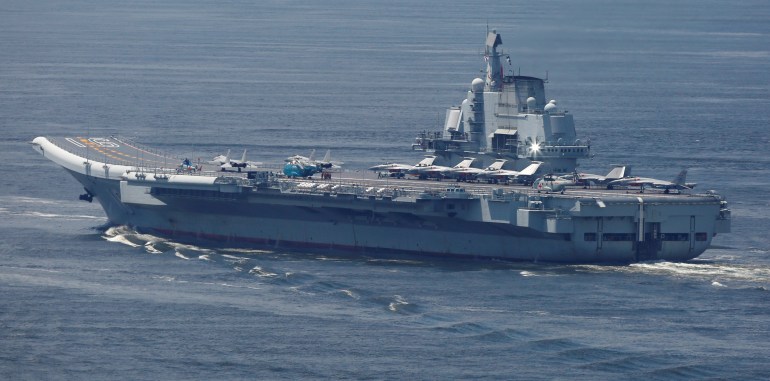 On Monday, Beijing announced that the carrier group, lead by the Liaoning, the country’s first aircraft carrier put into active service, carried out ‘routine’ drills in the waters near Taiwan [File: Bobby Yip/Reuters]
China considers Taiwan, where the mainland’s defeated nationalists fled in 1949 after losing the civil war, to be a territory awaiting reunification, by force if necessary.Taiwan in recent days reported growing air incursions by Beijing. Joseph Wu, Taiwan’s foreign minister, has called the approach “self-defeating.”
The US has voiced concern about the Chinese moves and warned against the use of coercion against Taiwan.
Under the Taiwan Relations Act approved by Congress when the US switched recognition, Washington is required to provide Taiwan with weapons for its self-defence.
The easing of rules comes amid soaring tensions between the US and China on multiple fronts.
On Friday, the US Senate Foreign Relations Committee announced that it will consider sweeping legislation to counter China’s influence on April 21.
The “Strategic Competition Act of 2021” includes a range of diplomatic and strategic initiatives to counteract Beijing, reflecting hard-line sentiment on dealings with China members of both political parties.
The 280-page bill addresses economic competition with China, but also humanitarian and democratic values, such as imposing sanctions for the treatment of the minority Muslim Uighurs and supporting democracy in Hong Kong.
Relations with China is one of the most bipartisan issues in Washington, with both Democrats and Republicans generally backing efforts to do more to compete against Beijing.


No comments:
Post a Comment
Note: only a member of this blog may post a comment.