NEW YORK (AP) — The world solemnly marked the 20th anniversary of 9/11 on Saturday, remembering the dead, invoking the heroes and taking stock of the aftermath just weeks after the bloody end of the Afghanistan war that was launched in response to the terror attacks.
Victims’ relatives and four U.S. presidents paid respects at the sites where hijacked planes killed nearly 3,000 people in the deadliest act of terrorism on American soil.
Others gathered for observances from Portland, Maine, to Guam, or for volunteer projects on what has become a day of service in the U.S. Foreign leaders expressed sympathy over an attack that happened in the U.S. but claimed victims from more than 90 countries.
“It felt like an evil specter had descended on our world, but it was also a time when many people acted above and beyond the ordinary,” said Mike Low, whose daughter, Sara Low, was a flight attendant on the first plane that crashed.
“As we carry these 20 years forward, I find sustenance in a continuing appreciation for all of those who rose to be more than ordinary people,” the father told a ground zero crowd that included President Joe Biden and former presidents Barack Obama and Bill Clinton.
The anniversary unfolded under the pall of a pandemic and in the shadow of the U.S. withdrawal from Afghanistan, which is now ruled by the same Taliban militant group that gave safe haven to the 9/11 plotters.
“It’s hard because you hoped that this would just be a different time and a different world. But sometimes history starts to repeat itself and not in the best of ways,” Thea Trinidad, who lost her father in the attacks, said before reading victims’ names at the ceremony.
Bruce Springsteen and Broadway actors Kelli O’Hara and Chris Jackson sang at the commemoration, but by tradition, no politicians spoke there. In a video released Friday night, Biden addressed the continuing pain of loss but also spotlighted what he called the “central lesson” of Sept. 11: “that at our most vulnerable … unity is our greatest strength.”
Biden was also paying respects at the two other sites where the 9/11 conspirators crashed the jets: the Pentagon and a field near Shanksville, Pennsylvania.
At the Pennsylvania site — where passengers and crew fought to regain control of a plane believed to have been targeted at the U.S. Capitol or the White House — former President George W. Bush said Sept. 11 showed that Americans can come together despite their differences.
“So much of our politics has become a naked appeal to anger, fear and resentment,” said the president who was in office on 9/11. “On America’s day of trial and grief, I saw millions of people instinctively grab their neighbor’s hand and rally to the cause of one another. That is the America know.”
“It is the truest version of ourselves. It is what we have been and what we can be again.”
Calvin Wilson said a polarized country has “missed the message” of the heroism of the flight’s passengers and crew, which included his brother-in-law, LeRoy Homer.
“We don’t focus on the damage. We don’t focus on the hate. We don’t focus on retaliation. We don’t focus on revenge,” Wilson said before the ceremony. “We focus on the good that all of our loved ones have done.”
Former President Donald Trump visited a New York police station and a firehouse, praising responders’ bravery while criticizing Biden over the pullout from Afghanistan.
“It was gross incompetence,” said Trump, who was scheduled to provide commentary at a boxing match in Florida in the evening.
The attacks ushered in a new era of fear, war, patriotism and, eventually, polarization. They also redefined security, changing airport checkpoints, police practices and the government’s surveillance powers.
A “war on terror” led to invasions of Iraq and Afghanistan, where the longest U.S. war ended last month with a hasty, massive airlift punctuated by a suicide bombing that killed 169 Afghans and 13 American service members and was attributed to a branch of the Islamic State extremist group. The U.S. is now concerned that al-Qaida, the terror network behind 9/11, may regroup in Afghanistan, where the Taliban flag once again flew over the presidential palace on Saturday.
Two decades after helping to triage and treat injured colleagues at the Pentagon on Sept. 11, retired Army Col. Malcolm Bruce Westcott is saddened and frustrated by the continued threat of terrorism.
“I always felt that my generation, my military cohort, would take care of it — we wouldn’t pass it on to anybody else,” said Westcott, of Greensboro, Georgia. “And we passed it on.”
At ground zero, multiple victims’ relatives thanked the troops who fought in Afghanistan, while Melissa Pullis said she was “just happy all the troops are out of Afghanistan.”
“We can’t lose any more military. We don’t even know why we’re fighting, and 20 years went down the drain,” said Pullis, who lost her husband, Edward, and whose son Edward Jr. is serving on the USS Ronald Reagan.
At this point, many of the relatives reciting victims’ names are too young to have known their lost kin. But the families spoke of lives cut short, milestones missed and a loss that still feels immediate. Several also pleaded for a return of the solidarity that surged for a time after Sept. 11 but soon gave way.
Muslim Americans endured suspicion, surveillance and hate crimes. Schisms and resentments grew over the balance between tolerance and vigilance, the meaning of patriotism, the proper way to honor the dead and the scope of a promise to “never forget.”
Trinidad was 10 when she overheard her dad, Michael, saying goodbye to her mother by phone from the burning trade center. She remembers the pain but also the fellowship of the days that followed, when all of New York “felt like it was family.”
“Now, when I feel like the world is so divided, I just wish that we can go back to that,” said Trinidad, of Orlando, Florida. “I feel like it would have been such a different world if we had just been able to hang on to that feeling.”
Democratic Republic of the Congo is seeking what it says is a fairer share of its vast mineral wealth.
Felix Tshisekedi, the president of the Democratic Republic of the Congo (DRC), has called for a review of mining contracts signed with China in 2008 by his predecessor, saying he wanted to get fairer deals.
A statement after a cabinet meeting on Friday said Tshisekedi called for the “technical and financial details of Sino-Congolese contracts” at the next meeting.
“DR Congo is sorely lacking in infrastructure and this hampers its development,” the statement said.
Former President Joseph Kabila, who held power from 2001 to 2019, negotiated a highly contentious minerals-for-infrastructure contract with the Chinese in 2008 valued at $9bn.
But the deal was reduced to two-thirds of that amount under pressure from the International Monetary Fund (IMF), which noted the severe effect it had on the country’s finances.
To date, about $2.74bn has been disbursed by the Chinese so far.
Former Chinese President Jiang Zemin (L) escorts Former President Joseph Kabila of the Democratic Republic of the Congo (DRC) as they review a guard of honour during a welcoming ceremony at the Great Hall of the People in Beijing [File: Goh Chai Hin/AFP]
During a visit to the mining town of Kolwezi in May, Tshisekedi announced his intention to renegotiate mining contracts, particularly those concluded by Kabila.
“It is not normal that those with whom the country has signed exploitation contracts are getting richer while our people remain poor,” he said.
“It is time for the country to readjust its contracts with the miners in order to seal win-win partnerships.”
Earlier this year, China granted some debt relief to the DRC aimed at helping it overcome the economic fallout from the pandemic.
As a result, the DRC did not have to repay its interest-free loans from China that matured at the end of 2020. The ministry did not say how much this amounted to.
According to data gathered by Johns Hopkins University’s China Africa Research Initiative, Chinese entities have extended 53 loans to the DRC between 2000 and 2018. Most of the lending was focused on the power, transport and mining sectors.
The coup leaders have promised a government of national unity to lead transition to civilian rule, but questions remain about what is next.
Guinea’s leader Alpha Conde used to tell journalists that he was the only one who could lead the country. He would also say the military would not overthrow him.
On Sunday, he was proved wrong.
An elite Special Forces unit stormed the presidential palace in the capital, Conakry, detaining the 83-year-old president. Hours later, coup leader Colonel Mamady Doumbouya appeared on state broadcaster Radio Television Guineenne, draped in the Guinean flag, introducing himself to surprised Guineans as the country’s new leader.
The putsch in Guinea threw the country into a state of uncertainty, caused the West African economic bloc to threaten sanctions and saw the price of aluminium reach its highest level in more than a decade. Guinea is the world’s biggest producer of bauxite, a mineral used to make aluminium.
Regional leaders immediately condemned the power grab, urging the coup leaders to restore constitutional order and release Conde.
In Conakry, the new military rulers were quick to try and reassure political and economic actors of their good intentions.
A government of national unity would be set up to lead the transition to civilian rule, Doumbouya told members of the overthrown government on Monday.
The new leadership would honour mining contracts, urging companies to continue operations, he said. Land and sea borders that were shut during the takeover reopened in fewer than 24 hours.
This, however, did not convince the Economic Community of the West African States (ECOWAS) regional bloc that went on to suspend Guinea from all its decision-making bodies. Two days later, the African Union followed suit.
Conde in 2010 became Guinea’s first democratically elected leader, his victory seen as putting an end to decades of authoritarian rule by the country’s two first presidents, Sekou Toure and Lansana Conte, who were in office for 26 and 24 years respectively.
Conde was re-elected for a second term in 2015. But he became increasingly disliked when he pushed through a constitutional referendum, backed by Russia, that Conde said allowed him to seek a controversial third term in October 2020 polls, which he won.
Sidy Yansane, a journalist and analyst in Conakry, said Conde brought the downfall on himself.
“Conde was very unpopular, even though people still voted for him. With the third mandate, Conde went too far,” he said by phone.
Questions loom
In his address to the nation on Sunday, Doumbouya said Conde’s removal was necessary and went on to blame his leadership for Guinea’s poverty, corruption, misrule and a lack of development. Doumbouya said a reform of the country’s ruling system and institutions was desperately needed.
“If you see the condition of our roads, of our hospitals, you realise that it is time for us to wake up,” Doumbouya said. What he did not say was when a transitional government could be put in place.
“Right now, people are just happy to see Conde gone,” Yansane said. “But pretty soon, they will need to see some actions from the junta; signs things are about to change, including a timetable for a transition.”
Residents cheer on army soldiers after the uprising that led to the toppling of president Alpha Conde in Kaloum neighbourhood of Conakry, Guinea [File: Souleymane/Reuters] Camara
So far, Sunday’s coup has been met with minimal resistance. Cheering crowds greeted the putschists as they drove through Conakry earlier this week.
Sally Bilaly Sow, a 29-year-old blogger and activist, said the coup could be an opportunity to reform and restructure state institutions.
“The important thing now is to not rush. To give an interim leadership enough time for reforms and prepare fresh elections,” Sow said by phone from Conakry.
Cellou Dalein Diallo, the only challenger to Conde in 2020 polls boycotted by the opposition, said he was open to participate but would not set an end date for a transition and a return to civilian rule.
The coup in Guinea is the fourth military takeover in West Africa this year following two coups in neighbouring Mali – the second one as recently as May this year – and a questionable succession in Chad raising concerns of a democratic backslide in the region.
In Mali, the military-led interim government is falling behind an 18-month schedule for general elections that should return the country to civilian rule.
In Chad, President Mahamat Deby, who succeeded his father Idriss Deby in April, seems in no rush to hand power to a civilian government.
An ECOWAS delegation that visited Conakry on Friday said its first meetings with the coup leaders had been “positive”.
The delegation also met Conde, ECOWAS Commission President Jean-Claude Kassi Brou said, referring to the overthrown leader as the “former president” indicating the regional bloc would not call for him to be reinstated.
Judge Yvonne Gonzalez Rogers issued a permanent injunction in the Epic v. Apple case on Friday morning, putting new restrictions on Apple’s App Store rules and bringing months of bitter legal jousting to a conclusion.
Under the new order, Apple is:
permanently restrained and enjoined from prohibiting developers from including in their apps and their metadata buttons, external links, or other calls to action that direct customers to purchasing mechanisms, in addition to In-App Purchasing and communicating with customers through points of contact obtained voluntarily from customers through account registration within the app.
In short, iOS apps must be allowed to direct users to payment options beyond those offered by Apple. The injunction is scheduled to take effect in 90 days — on December 9th — unless it is enjoined by a higher court.
In a separate judgment, the court affirmed that Epic Games was in breach of its contract with Apple when it implemented the alternative payment system in the Fortnite app. As a result, Epic must pay Apple 30 percent of all revenue collected through the system since it was implemented — a sum of more than $3.5 million.
In the full ruling, Judge Gonzalez Rogers explained her thinking on the issue in greater detail. Notably, the judge rejected both parties’ definition of the marketplace at issue in the case.
“The relevant market here is digital mobile gaming transactions, not gaming generally and not Apple’s own internal operating systems related to the App Store,” Gonzalez Rogers wrote.
Under that market definition, “the court cannot ultimately conclude that Apple is a monopolist under either federal or state antitrust laws,” she continued. “Nonetheless, the trial did show that Apple is engaging in anti-competitive conduct under California’s competition laws.”
Reached for comment, Apple cast the ruling as a victory for the App Store model.
“Today the Court has affirmed what we’ve known all along: the App Store is not in violation of antitrust law,” a representative said. “Apple faces rigorous competition in every segment in which we do business, and we believe customers and developers choose us because our products and services are the best in the world. We remain committed to ensuring the App Store is a safe and trusted marketplace.”
On Twitter, Epic CEO Tim Sweeney expressed disappointment in the order. “Today’s ruling isn’t a win for developers or for consumers,” Sweeney said. “Epic is fighting for fair competition among in-app payment methods and app stores for a billion consumers.” Separately, an Epic Games spokesperson told NPR that the company plans to appeal.
The new restrictions include echoes of some provisional anti-steering restrictions already placed on Apple outside of the US.
On September 1st, Apple agreed to allow outside signup links for “reader” apps like Netflix and Spotify, following a regulatory investigation in Japan. More recently, a South Korean law opened the door to alternate payment systems, although the practical impacts of the law are still unclear.
Apple and Epic Games have been at odds for years over the transaction fee system in the iOS App Store, which Apple sees as a necessary operating cost but Epic sees as a monopolistic tax.
The fight came to a head in August 2020 when Epic installed an alternative payment system in Fortnite to circumvent the App Store’s transaction fees. Apple responded by removing Fortnite from the App Store, which sparked an immediate legal complaint from Epic.
The subsequent trial was a brutal tug-of-war over the App Store model and Apple’s efforts to maintain control over software on iOS. Among other things, we learned about Apple’s strange accounting methods and charm offensive to keep major players like Netflix using in-app purchases.
The ruling is likely to have significant impacts outside of Apple. Google is already facing a similar lawsuit from Epic Games over its own efforts to maintain the Google Play Store as the central source of software on Android, drawing on elaborate deals with phone manufacturers.
NEW YORK (AP) — Three American presidents stood somberly side by side Saturday at the National September 11 Memorial in New York, sharing a moment of silence to mark the anniversary of the nation’s worst terrorist attack with a display of unity.
Presidents Joe Biden, Barack Obama and Bill Clinton gathered at the site where the World Trade Center towers fell two decades ago. Each man wore a blue ribbon and held his hands over his heart as a procession marched a flag through the memorial before hundreds of people, some carrying photos of loved ones lost in the attacks.
Before the event began, a jet flew overhead in an eerie echo of the attacks, drawing a glance from Biden toward the sky. For much of the ceremony he stood with his arms crossed and head bowed, listening while the names of the victims were read. At one point, he wiped a tear from his eye.
Biden was a senator when hijackers commandeered four planes and carried out the attack. He was Obama’s vice president in 2011 when the country observed the 10th anniversary of the strikes. Saturday’s commemoration was his first as commander in chief, beginning in New York City and culminating late afternoon at the Pentagon, where the world’s mightiest military suffered an unthinkable blow to its very home.
In between he visited Shanksville, Pennsylvania, where passengers brought down a hijacked plane that was headed for the U.S. Capitol. Biden and his wife, Jill, walked with relatives of the crash victims into the grassy field where the jet came to rest.
He reflected on the need for unity when he dropped by the Shanksville Volunteer Fire Department to deliver Bud Light and thank first responders who responded to the plane crash on Sept. 11.
“Everyone says Biden, ’Why do you keep insisting on trying to bring the country together?” the president told reporters. “That’s the thing that’s going to affect our well-being more than anything else.”
It is now Biden who shoulders the responsibility borne by his predecessors to prevent another strike. He must do that against fears of a rise in terrorism after the hasty U.S. withdrawal from Afghanistan, where those who planned the Sept. 11 attacks were sheltered.
But on a day when his nation recalled its shock and sorrow, Biden left the speech-making to others.
Biden’s vice president, Kamala Harris, spoke in Shanksville at the Flight 93 National Memorial, praising the courage of those passengers and the resilience of Americans who came together in the days after the attacks.
“In a time of outright terror, we turned toward each other,” she said. “If we do the hard work of working together as Americans, if we remain united in purpose, we will be prepared for whatever comes next.”
Former President George W. Bush, speaking before Harris, recalled how 9/11 showed that Americans could unite despite their differences. It was a message, he said, that was needed today.
“So much of our politics have become a naked appeal to anger, fear and resentment,” Bush said. “On America’s day of trial and grief, I saw millions of people instinctively grab for a neighbor’s hand, and rally for the cause of one another. That is the America I know.”
Biden, speaking at the firehouse later, praised Bush’s message of unity, and mentioned that he had taken photos with some boys wearing Trump hats at the firehouse. Biden framed the need for unity as a crucial to the success of democracies, asking “Are we going to, in the next four, five, six, 10 years, demonstrate that democracies can work, or not?”
Former President Donald Trump skipped the official 9/11 memorial ceremonies and instead visited a fire station and police precinct in New York.
While Biden had no prepared remarks of his own Saturday, he did offer praise for Bush’s words, telling reporters in Pennsylvania that he thought the former president “made a really good speech today. Genuinely.”
But unity was a theme that Biden emphasized in a taped address released by the White House late Friday. He spoke about the “true sense of national unity” that emerged after the attacks, seen in “heroism everywhere — in places expected and unexpected.”
“To me that’s the central lesson of September 11,” he said. “Unity is our greatest strength.”
Biden is the fourth president to console the nation on the anniversary of that dark day, one that has shaped many of the most consequential domestic and foreign policy decisions made by the chief executives over the past two decades.
Bush was reading a book to Florida schoolchildren when the planes slammed into the World Trade Center. He spent that day being kept out of Washington for security reasons — a decision then-Sen. Biden urged him to reconsider, the current president has written — and then delivered a brief, halting speech that night from the White House to a terrified nation.
The terrorist attack would define Bush’s presidency. The following year, he chose Ellis Island as the location to deliver his first anniversary address, the Statue of Liberty over his shoulder as he pledged, “What our enemies have begun, we will finish.”
The wars in Iraq and Afghanistan were still deadly when Obama visited the Pentagon to mark his first Sept. 11 in office in 2009.
By the time Obama spoke at the 10th anniversary, attack mastermind Osama bin Laden was dead, killed in a May 2011 Navy SEAL raid. Though the nation remained entangled overseas, and vigilant against terrorist threats, the anniversary became more about healing.
Trump pledged to get the U.S. out of Afghanistan, but his words during his first Sept. 11 anniversary ceremony in 2017 were a vivid warning to terrorists, telling “these savage killers that there is no dark corner beyond our reach, no sanctuary beyond our grasp, and nowhere to hide anywhere on this very large earth.”
While fleeing from his brother Esau, Jacob ended up in the land where his uncle Laban lived. He falls in love with Laban’s daughter Rachel and agrees to work seven years for her. At the end of the seven years, Laban deceives Jacob by giving him Leah instead and he treated Jacob unfairly in other agreements that followed.
Jacob ends up marrying both of Laban’s daughters and eventually came to the point where he was ready to leave to build his own household. Laban persuades him to stay and they come to an agreement that made Jacob wealthy at Laban’s expense. In the end, Jacob leaves secretly but is pursued by Laban. Laban catches him up but didn’t do him any harm since God warned him in a dream.
Family Can Take Advantage of You
The first lesson we can learn from Jacob and Laban is that family can take advantage of you. Laban and Jacob were related. Laban was Jacob’s uncle. Despite them being related, Laban took advantage of Jacob multiple times.
First, he took advantage of Jacob by giving him Leah as a wife for seven years of work when initially both of them agreed on him working for Rachel. Then he made him work another seven years for Rachel. At another point, Jacob and Laban made an agreement about Jacob’s wages being “every speckled or spotted sheep, every dark-colored lamb and every spotted or speckled goat” (Genesis 30:32 NIV). But then, The Bible states that, that the same day Laban removed all the sheep and goats that Jacob and he agreed would be his payment and placed them in the care of his sons (Genesis 30:35). Jacob also told his wives that Laban “has cheated me by changing my wages ten times” (Genesis 31:7 NIV).
Laban Took Advantage of His Daughters
Laban not only took advantage of Jacob but also his own daughters. He took advantage of Leah by having her pretend to be Rachel to get Jacob to work another seven years. And about Laban, both of his daughters said “does he not regard us as foreigners? Not only has he sold us, but he has used up what was paid for us” (Genesis 31:15 NIV). These examples remind us that just because a person is considered a family member, it doesn’t mean they wouldn’t take advantage of you.
Protect Yourself From Being Taken Advantage Of
Learning from Jacob’s experience with Laban, we should be careful when we make agreements with family members. Because it is with a family member, we may not take the agreement seriously. We may neglect to work out the details that can lead to problems if things go bad. So remember Jacob and Laban when you are making agreements with family and do what’s necessary to protect yourself from being taken advantage of, especially if it’s business-related.
Listen To The Warning Signs
The next lesson we can learn from Jacob and Laban is to listen to the warning signs. This is what Jacob did when he realized that Laban’s and Laban’s son’s attitudes were changing towards him and when God told him to return to the land of his ancestors (Genesis 31:1-3). If Jacob ignored the warning signs, he may have had an unfortunate end.
Based on how Jacob saw Laban’s attitude towards him changing and God telling him to go, Jacob decided to leave without telling him. Jacob knew the type of person Laban was. How Laban treated him in the past were warning signs of what he was capable of. Not surprisingly, Jacob’s decision to go quietly was a smart move.
Laban Would Have Harmed Jacob
When Laban heard Jacob had left, Laban, “taking his relatives with him, he pursued Jacob for seven days and caught up with him” (Genesis 31:23 NIV). Laban didn’t have good intentions while he was pursuing Jacob because God had to tell him “be careful not to say anything to Jacob, either good or bad” (Genesis 31:24). Then Laban said it himself when he told Jacob “I have the power to harm you” but God warned him to be careful (Genesis 31:29 NIV).
Who knows how the story may have gone if Jacob ignored Laban’s changing attitude towards him and God’s instructions to leave? Jacob, thinking that Laban would have taken his daughters from him by force if he told him he was leaving was a wise assessment (Genesis 31:31).
Take Action When You See The Warning Signs
Like Jacob, we should listen to the warning signs and take the necessary actions to protect ourselves. It’s easy to explain away the warning signs when we are comfortable or don’t want to face the reality of what the signs may mean. Since we have been analyzing Jacob and Laban’s work-related issues, think of a job for example.
You may notice that you along with your coworkers’ benefits are slowly being taken away and the responsibilities of some of the people who left the company are being divided among existing workers without extra pay. These are signs that a company isn’t doing well and that you should probably consider looking for another job. But thinking the company is too big to fail or that you are guaranteed some benefit if it does, could turn out disastrous for you.
Proverbs 27:12 states “A prudent person foresees danger and takes precautions. The simpleton goes blindly on and suffers the consequences” (NLT). Like Jacob who foresaw the danger in Laban and acted accordingly, we should listen to the warning signs and take precautions to avoid suffering.
A Bad Decision Can Lead To A Series Of Problems
The third lesson we can learn from Jacob and Laban is that a bad decision can lead to a series of problems. Laban’s decision to deceive Jacob by giving him Leah in marriage instead of Rachel led to a series of problems that Laban could never have imagined.
Generational Problems
Because Rachel was the one Jacob loved, in addition to Leah he married Rachel as well. Had Laban not trick him, he would have only had one wife. Then, because Jacob didn’t love Leah, The Bible says God “enabled her to conceive, but Rachel remained childless” (Genesis 29:31 NIV). That then led to a competition between Rachel and Leah leading Jacob to have children with not only them but their servant girls also! This eventually led to Joseph being mistreated and eventually sold as a slave by his older brothers probably because he didn’t share the same mother with any of them.
Jacob continued on his way and went toward the land of the East.Suddenly he came upon a well out in the fields with three flocks of sheep lying around it. The flocks were watered from this well, which had a large stone over the opening.Whenever all the flocks came together there, the shepherds would roll the stone back and water them. Then they would put the stone back in place.
Jacob asked the shepherds, “My friends, where are you from?”
“From Haran,” they answered.
He asked, “Do you know Laban, grandson of Nahor?”
“Yes, we do,” they answered.
“Is he well?” he asked.
“He is well,” they answered. “Look, here comes his daughter Rachel with his flock.”
Jacob said, “Since it is still broad daylight and not yet time to bring the flocks in, why don't you water them and take them back to pasture?”
They answered, “We can't do that until all the flocks are here and the stone has been rolled back; then we will water the flocks.”
While Jacob was still talking with them, Rachel arrived with the flock. When Jacob saw Rachel with his uncle Laban's flock, he went to the well, rolled the stone back, and watered the sheep. Then he kissed her and began to cry for joy. He told her, “I am your father's relative, the son of Rebecca.”
She ran to tell her father; and when he heard the news about his nephew Jacob, he ran to meet him, hugged him and kissed him, and brought him into the house. When Jacob told Laban everything that had happened, Laban said, “Yes, indeed, you are my own flesh and blood.” Jacob stayed there a whole month.
Laban said to Jacob, “You shouldn't work for me for nothing just because you are my relative. How much pay do you want?” Laban had two daughters; the older was named Leah, and the younger Rachel. Leah had lovely eyes, but Rachel was shapely and beautiful.
Jacob was in love with Rachel, so he said, “I will work seven years for you, if you will let me marry Rachel.”
Laban answered, “I would rather give her to you than to anyone else; stay here with me.” Jacob worked seven years so that he could have Rachel, and the time seemed like only a few days to him, because he loved her.
Then Jacob said to Laban, “The time is up; let me marry your daughter.” So Laban gave a wedding feast and invited everyone. But that night, instead of Rachel, he took Leah to Jacob, and Jacob had intercourse with her. ( Laban gave his slave woman Zilpah to his daughter Leah as her maid.) Not until the next morning did Jacob discover that it was Leah. He went to Laban and said, “Why did you do this to me? I worked to get Rachel. Why have you tricked me?”
Laban answered, “It is not the custom here to give the younger daughter in marriage before the older. Wait until the week's marriage celebrations are over, and I will give you Rachel, if you will work for me another seven years.”
Jacob agreed, and when the week of marriage celebrations was over, Laban gave him his daughter Rachel as his wife. ( Laban gave his slave woman Bilhah to his daughter Rachel as her maid.) Jacob had intercourse with Rachel also, and he loved her more than Leah. Then he worked for Laban another seven years.
When the Lord saw that Leah was loved less than Rachel, he made it possible for her to have children, but Rachel remained childless. Leah became pregnant and gave birth to a son. She said, “The Lord has seen my trouble, and now my husband will love me”; so she named him Reuben. She became pregnant again and gave birth to another son. She said, “The Lord has given me this son also, because he heard that I was not loved”; so she named him Simeon. Once again she became pregnant and gave birth to another son. She said, “Now my husband will be bound more tightly to me, because I have borne him three sons”; so she named him Levi. Then she became pregnant again and gave birth to another son. She said, “This time I will praise the Lord”; so she named him Judah. Then she stopped having children.
But Rachel had not borne Jacob any children, and so she became jealous of her sister and said to Jacob, “Give me children, or I will die.”
Jacob became angry with Rachel and said, “I can't take the place of God. He is the one who keeps you from having children.”
She said, “Here is my slave Bilhah; sleep with her, so that she can have a child for me. In this way I can become a mother through her.” So she gave Bilhah to her husband, and he had intercourse with her. Bilhah became pregnant and bore Jacob a son. Rachel said, “God has judged in my favor. He has heard my prayer and has given me a son”; so she named him Dan. Bilhah became pregnant again and bore Jacob a second son. Rachel said, “I have fought a hard fight with my sister, but I have won”; so she named him Naphtali.
When Leah realized that she had stopped having children, she gave her slave Zilpah to Jacob as his wife. Then Zilpah bore Jacob a son. Leah said, “I have been lucky”; so she named him Gad. Zilpah bore Jacob another son, and Leah said, “How happy I am! Now women will call me happy”; so she named him Asher.
During the wheat harvest Reuben went into the fields and found mandrakes, which he brought to his mother Leah. Rachel said to Leah, “Please give me some of your son's mandrakes.”
Leah answered, “Isn't it enough that you have taken away my husband? Now you are even trying to take away my son's mandrakes.”
Rachel said, “If you will give me your son's mandrakes, you can sleep with Jacob tonight.”
When Jacob came in from the fields in the evening, Leah went out to meet him and said, “You are going to sleep with me tonight, because I have paid for you with my son's mandrakes.” So he had intercourse with her that night.
God answered Leah's prayer, and she became pregnant and bore Jacob a fifth son. Leah said, “God has given me my reward, because I gave my slave to my husband”; so she named her son Issachar. Leah became pregnant again and bore Jacob a sixth son. She said, “God has given me a fine gift. Now my husband will accept me, because I have borne him six sons”; so she named him Zebulun. Later she bore a daughter, whom she named Dinah.
Then God remembered Rachel; he answered her prayer and made it possible for her to have children. She became pregnant and gave birth to a son. She said, “God has taken away my disgrace by giving me a son. May the Lord give me another son”; so she named him Joseph.
After the birth of Joseph, Jacob said to Laban, “Let me go, so that I can return home. Give me my wives and children that I have earned by working for you, and I will leave. You know how well I have served you.”
Laban said to him, “Let me say this: I have learned by divination that the Lord has blessed me because of you. Name your wages, and I will pay them.”
Jacob answered, “You know how I have worked for you and how your flocks have prospered under my care. The little you had before I came has grown enormously, and the Lord has blessed you wherever I went. Now it is time for me to look out for my own interests.”
“What shall I pay you?” Laban asked.
Jacob answered, “I don't want any wages. I will continue to take care of your flocks if you agree to this suggestion: Let me go through all your flocks today and take every black lamb and every spotted or speckled young goat. That is all the wages I want. In the future you can easily find out if I have been honest. When you come to check up on my wages, if I have any goat that isn't speckled or spotted or any sheep that isn't black, you will know that it has been stolen.”
Laban answered, “Agreed. We will do as you suggest.” But that day Laban removed the male goats that had stripes or spots and all the females that were speckled and spotted or which had white on them; he also removed all the black sheep. He put his sons in charge of them, and then went away from Jacob with this flock as far as he could travel in three days. Jacob took care of the rest of Laban's flocks.
Jacob got green branches of poplar, almond, and plane trees and stripped off some of the bark so that the branches had white stripes on them. He placed these branches in front of the flocks at their drinking troughs. He put them there, because the animals mated when they came to drink. So when the goats bred in front of the branches, they produced young that were streaked, speckled, and spotted.
Jacob kept the sheep separate from the goats and made them face in the direction of the streaked and black animals of Laban's flock. In this way he built up his own flock and kept it apart from Laban's.
When the healthy animals were mating, Jacob put the branches in front of them at the drinking troughs, so that they would breed among the branches. But he did not put the branches in front of the weak animals. Soon Laban had all the weak animals, and Jacob all the healthy ones. In this way Jacob became very wealthy. He had many flocks, slaves, camels, and donkeys.
Jacob heard that Laban's sons were saying, “Jacob has taken everything that belonged to our father. He got all his wealth from what our father owned.” He also saw that Laban was no longer as friendly as he had been earlier. Then the Lord said to him, “Go back to the land of your fathers and to your relatives. I will be with you.”
So Jacob sent word to Rachel and Leah to meet him in the field where his flocks were. He said to them, “I have noticed that your father is not as friendly toward me as he used to be; but my father's God has been with me. You both know that I have worked for your father with all my strength. Yet he has cheated me and changed my wages ten times. But God did not let him harm me. Whenever Laban said, ‘The speckled goats shall be your wages,’ all the flocks produced speckled young. When he said, ‘The striped goats shall be your wages,’ all the flocks produced striped young. God has taken flocks away from your father and given them to me.
“During the breeding season I had a dream, and I saw that the male goats that were mating were striped, spotted, and speckled. The angel of God spoke to me in the dream and said, ‘Jacob!’ ‘Yes,’ I answered. ‘Look,’ he continued, ‘all the male goats that are mating are striped, spotted, and speckled. I am making this happen because I have seen all that Laban is doing to you. I am the God who appeared to you at Bethel, where you dedicated a stone as a memorial by pouring olive oil on it and where you made a vow to me. Now get ready and go back to the land where you were born.’”
Rachel and Leah answered Jacob, “There is nothing left for us to inherit from our father. He treats us like foreigners. He sold us, and now he has spent all the money he was paid for us. All this wealth which God has taken from our father belongs to us and to our children. Do whatever God has told you.”
So Jacob got ready to go back to his father in the land of Canaan. He put his children and his wives on the camels, and drove all his flocks ahead of him, with everything that he had gotten in Mesopotamia. Laban had gone to shear his sheep, and during his absence Rachel stole the household gods that belonged to her father. Jacob deceived Laban by not letting him know that he was leaving. He took everything he owned and left in a hurry. He crossed the Euphrates River and started for the hill country of Gilead.
Three days later Laban was told that Jacob had fled. He took his men with him and pursued Jacob for seven days until he caught up with him in the hill country of Gilead. In a dream that night God came to Laban and said to him, “Be careful not to threaten Jacob in any way.” Jacob had set up his camp on a mountain, and Laban set up his camp with his relatives in the hill country of Gilead.
Laban said to Jacob, “Why did you deceive me and carry off my daughters like women captured in war? Why did you deceive me and slip away without telling me? If you had told me, I would have sent you on your way with rejoicing and singing to the music of tambourines and harps. You did not even let me kiss my grandchildren and my daughters good-bye. That was a foolish thing to do! I have the power to do you harm, but last night the God of your father warned me not to threaten you in any way. I know that you left because you were so anxious to get back home, but why did you steal my household gods?”
Jacob answered, “I was afraid, because I thought that you might take your daughters away from me. But if you find that anyone here has your gods, he will be put to death. Here, with our men as witnesses, look for anything that belongs to you and take what is yours.” Jacob did not know that Rachel had stolen Laban's gods.
Laban went and searched Jacob's tent; then he went into Leah's tent, and the tent of the two slave women, but he did not find his gods. Then he went into Rachel's tent. Rachel had taken the household gods and put them in a camel's saddlebag and was sitting on them. Laban searched through the whole tent, but did not find them. Rachel said to her father, “Do not be angry with me, sir, but I am not able to stand up in your presence; I am having my monthly period.” Laban searched but did not find his household gods.
Then Jacob lost his temper. “What crime have I committed?” he asked angrily. “What law have I broken that gives you the right to hunt me down? Now that you have searched through all my belongings, what household article have you found that belongs to you? Put it out here where your men and mine can see it, and let them decide which one of us is right. I have been with you now for twenty years; your sheep and your goats have not failed to reproduce, and I have not eaten any rams from your flocks. Whenever a sheep was killed by wild animals, I always bore the loss myself. I didn't take it to you to show that it was not my fault. You demanded that I make good anything that was stolen during the day or during the night. Many times I suffered from the heat during the day and from the cold at night. I was not able to sleep. It was like that for the whole twenty years I was with you. For fourteen years I worked to win your two daughters—and six years for your flocks. And even then, you changed my wages ten times. If the God of my fathers, the God of Abraham and Isaac, had not been with me, you would have already sent me away empty-handed. But God has seen my trouble and the work I have done, and last night he gave his judgment.”
Laban answered Jacob, “These young women are my daughters; their children belong to me, and these flocks are mine. In fact, everything you see here belongs to me. But since I can do nothing to keep my daughters and their children, I am ready to make an agreement with you. Let us make a pile of stones to remind us of our agreement.”
So Jacob got a stone and set it up as a memorial. He told his men to gather some rocks and pile them up. Then they ate a meal beside the pile of rocks. Laban named it Jegar Sahadutha, while Jacob named it Galeed. Laban said to Jacob, “This pile of rocks will be a reminder for both of us.” That is why that place was named Galeed. Laban also said, “May the Lord keep an eye on us while we are separated from each other.” So the place was also named Mizpah. Laban went on, “If you mistreat my daughters or if you marry other women, even though I don't know about it, remember that God is watching us. Here are the rocks that I have piled up between us, and here is the memorial stone. Both this pile and this memorial stone are reminders. I will never go beyond this pile to attack you, and you must never go beyond it or beyond this memorial stone to attack me. The God of Abraham and the God of Nahor will judge between us.” Then, in the name of the God whom his father Isaac worshiped, Jacob solemnly vowed to keep this promise. He killed an animal, which he offered as a sacrifice on the mountain, and he invited his men to the meal. After they had eaten, they spent the night on the mountain. Early the next morning Laban kissed his grandchildren and his daughters good-bye, and left to go back home.
Liberian president George Weah has admonished his peers to ensure that presidential term limits are respected if ECOWAS is to get rid of coup d’etats in the region.
Weah made these remarks in reference to the recent military overthrow of Alpha Conde’s government in Guinea. Conde had manipulated his country’s constitution to pave the way for him to run for a third term.
And last week Conde’s own presidential guard removed him from office citing much the same reasons.
West Africans now wonder if the other culprit, Cote d’Ivoire’s Alassane Outtara is the next sitting duck given that he is currently enjoying a similar illegal third term after also having manipulated his country’s constitution.
Investigations by DNT has revealed that internal party politics and failure of leaders to groom their successor are to blame. In the case of Outtara, his party felt only he could win the presidency for them after Prime Minister Amadou Gon Coulibaly died in office.
Nine months later his replacement Hamed Bakayoko also died at a young age of 56. But rather than ceding the party’s presidential candidacy to the third Prime Minister Patrick Achi, and Akan that he did not trust, outtara decided to run again for what Ivorians are calling an illegal third term.
But there is good news to point to.
Last years some party elements seeking favors approached then Niger president Mahamadou Isoufou to copy Outtara and Conde to run for a third term. but not only did Isoufou refused to heed their advice, he threw then in jail for suggesting it.
That development in Niger, Conde’s removal, and the long enduring democracy in Ghana where no leader in the Fourth Republic has tried , or would ever try, to over stay his term, gives hope that George Weah may not need to worry much about future instances of presidential overstay.
DNT News with correspondence reporting from Julius Ouya.


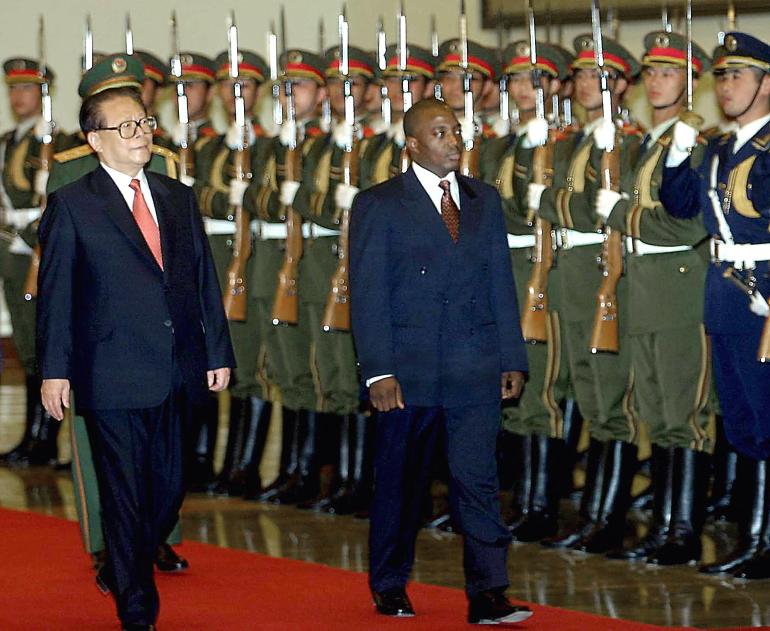 Former Chinese President Jiang Zemin (L) escorts Former President Joseph Kabila of the Democratic Republic of the Congo (DRC) as they review a guard of honour during a welcoming ceremony at the Great Hall of the People in Beijing [File: Goh Chai Hin/AFP]
 Residents cheer on army soldiers after the uprising that led to the toppling of president Alpha Conde in Kaloum neighbourhood of Conakry, Guinea [File: Souleymane/Reuters] Camara


