Translate

Wednesday, 15 September 2021

Naftali Bennett makes first visit to Egypt by an Israeli PM in a decade


Israeli Prime Minister Naftali Bennett is holding talks with Egyptian President Abdul Fattah al-Sisi in the Red Sea resort of Sharm el-Sheikh.

It is the first official trip to Egypt by an Israeli premier for a decade.

The Egyptian presidency said the two leaders would discuss bilateral and regional issues, and ways to revive the Israeli-Palestinian peace process.

Mr Bennett, who succeeded Benjamin Netanyahu in June, received an invitation to visit Egypt last month.

Mr Netanyahu was the last Israeli prime minister to make an official visit to Egypt in 2011, when he met Hosni Mubarak just over a month before he was ousted by a popular uprising.

He is reported to have also travelled secretly to Egypt in 2018 for unofficial talks with Mr Sisi, who led the military’s overthrow of Mubarak’s democratically elected successor in 2013 following mass protests.

Egypt became the first Arab country to sign a peace treaty with Israel in 1979, but relations between the neighbours have often been cool.

Correspondents say tensions surrounding the Gaza Strip are likely to dominate the meeting in Sharm el-Sheikh.

Egypt has always played a major role in efforts to mediate between Israel and Palestinian militant groups in the territory.

It brokered a ceasefire that ended an 11-day conflict in May, during which at least 260 people were killed in Gaza and 13 people were killed in Israel.

But its efforts to negotiate a long-term truce have been tested by a rise in cross-border violence in recent weeks.

The Israeli military said earlier on Monday it had struck Hamas militant targets in Gaza after rockets were fired at Israel for the third night in a row

…………………………………………………………

Haiti PM Ariel Henry banned from leaving country amid murder inquiry


Haiti’s Prime Minister Ariel Henry has been banned from leaving the country amid an investigation into his alleged involvement in the assassination of President Jovenel Moïse.

A prosecutor is seeking charges against Mr Henry, who has been asked to explain his links with a suspect in the killing, Joseph Felix Badio.

Records show the two men had multiple phone calls just hours after the assassination, prosecutors say.

Mr Moïse was killed at home on 7 July.

He was shot dead after gunmen stormed his private residence in a suburb of the capital, Port-au-Prince. His death triggered a political crisis which was exacerbated when a huge earthquake struck the south of Haiti a month ago.

Prosecutors have said records obtained from phone operator Digicel have confirmed that Mr Badio – a justice ministry official accused of planning the assassination – and Mr Henry spoke twice shortly after Mr Moïse’s killing.

Geolocation data also showed that Mr Badio, who disappeared after the murder and is currently being sought by police, was speaking from the scene of the crime. He has not publicly commented on these claims.

In a letter seen by the BBC on Tuesday, Chief Prosecutor Bed-Ford Claude urged the judge investigating the killing to charge Mr Henry for his “suspected” involvement in the case.

No further details were provided and it is not clear what exact charges are being sought against Mr Henry.

The prime minister recently rejected what he called “diversionary tactics” intended to “sow confusion” without responding to the specific accusations against him.

Mr Henry has previously told local media that he knew Mr Badio and defended him, adding that he did not believe he was involved because he did not have the means.

Mr Henry was given a deadline of Tuesday 14 September to supply the investigation with information..

It comes as authorities double down on their efforts to arrest additional suspects in the assassination.

Police say there are now 44 people held in custody in connection with the plot, including 18 retired members of the Colombian militia

…………………………………………………………

Tuesday, 14 September 2021

Arc de Triomphe wrapped in fabric in tribute to artist

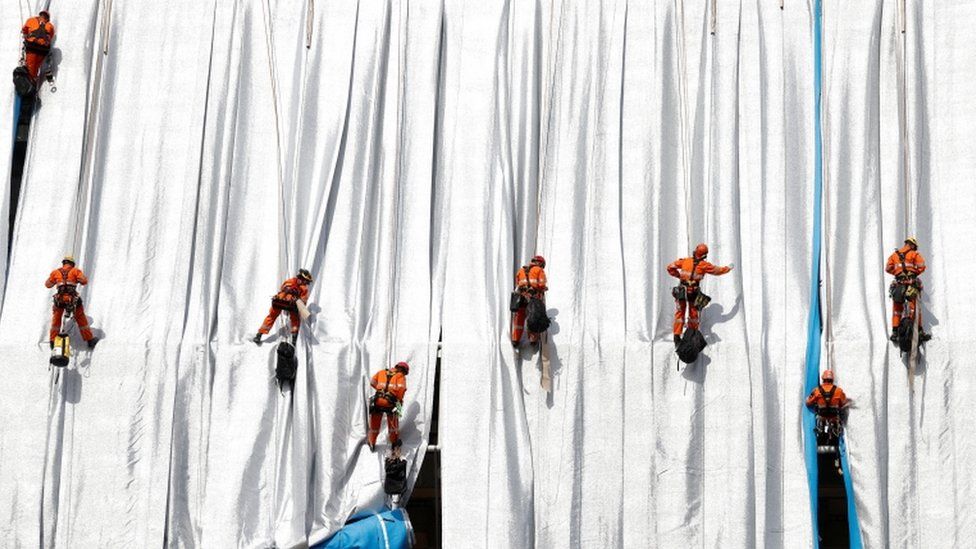
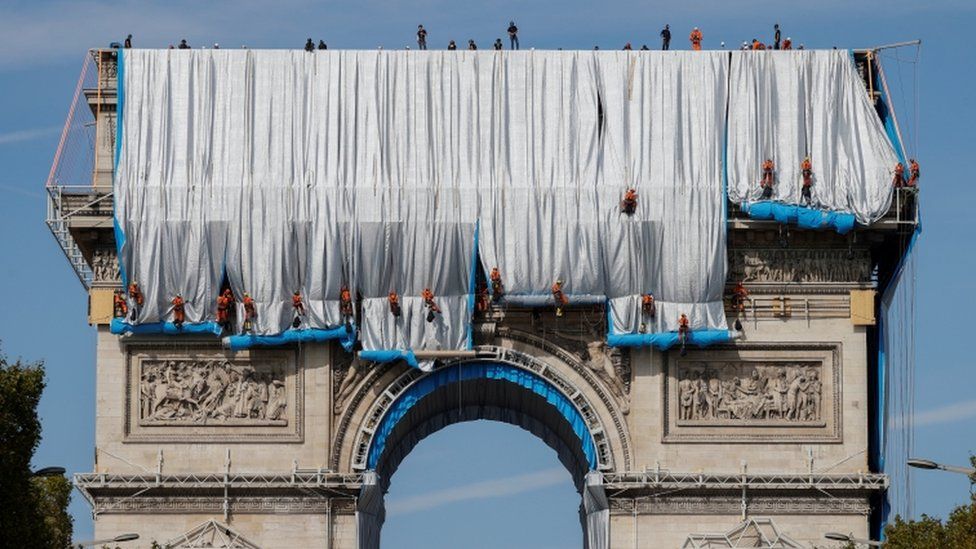
Giants sheets of fabric have been draped down the Arc de Triomphe monument in Paris in tribute to a late artist’s unfulfilled dream.


The memorial in the French capital will be covered in 25,000 sq m (270,000 sq ft) of plastic wrapping over the next few days.

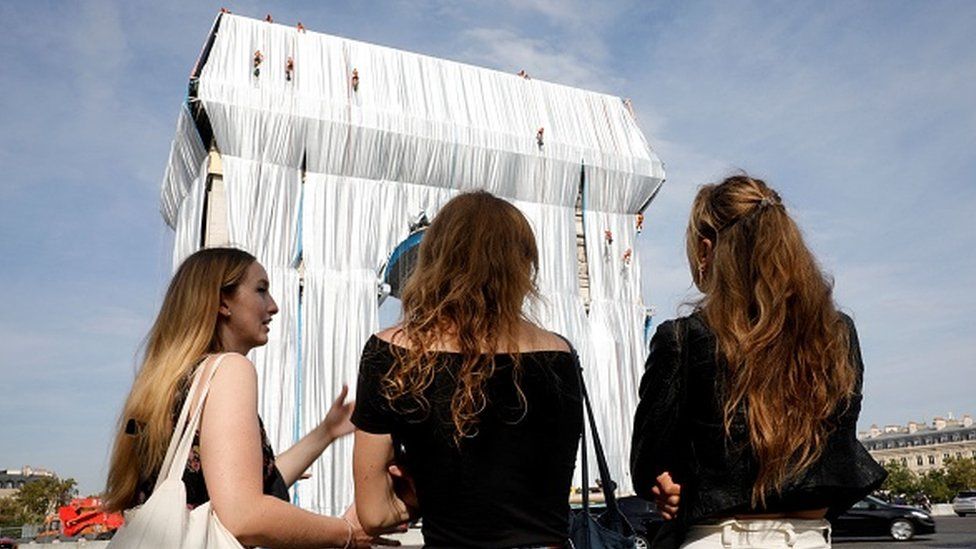
Crowds have been gathering near the monument on the Champs-Élysées since work began on the installation on Sunday.

The idea was first imagined by Bulgarian-born artist Christo, who died last year, and his late wife and collaborator Jeanne-Claude.

Known for wrapping famous landmarks in fabric, Christo had dreamed of sheathing the 50m-high monument since renting a nearby apartment in the 1960s.

Workers install a shimmering wrapper to envelop Paris landmark, the Arc de Triomphe
image caption Dozens of workers are involved in the project

Christo, who always worked with his wife Jeanne-Claude, famously covered the Reichstag in Berlin and the Pont-Neuf in Paris with reams of cloth.

But he never managed to realise the Arc de Triomphe project.

Now, that vision has finally been brought to life by Christo’s nephew, Vladimir Javacheff, at a cost of about €14m (£11.9m; $16.54m).

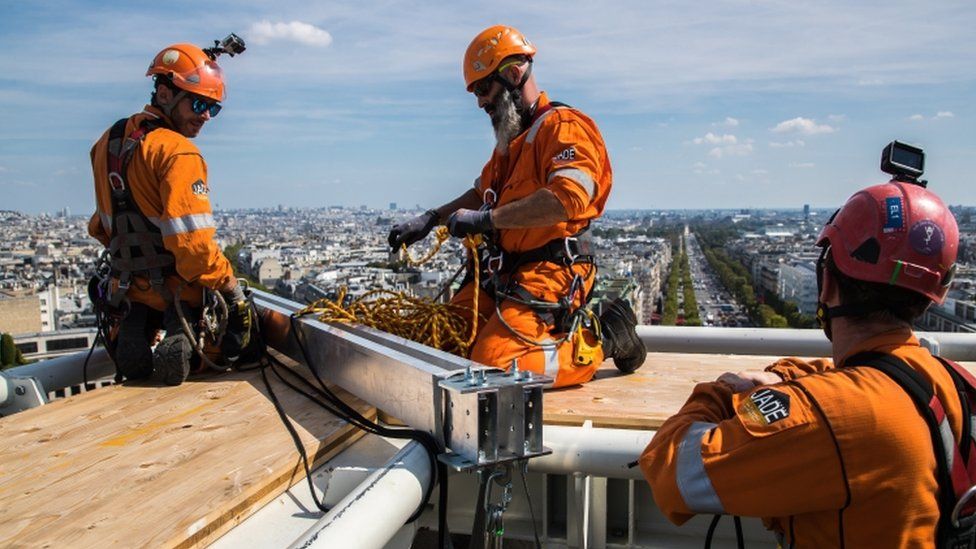
Workers prepare the assembly of the Arc de Triomphe installation
image caption The installation is expected to be completed on Saturday

He collaborated with the Pompidou museum and French authorities to bring the project to fruition.

“Today is one of the most spectacular moments of the installation,” said Mr Javacheff. “The wrapped Arc de Triomphe starts to take form and approach the vision that was a lifelong dream for Christo and Jeanne-Claude.”

Workers install a shimmering wrapper to envelop Paris landmark, the Arc de Triomphe
image caption The Arc is being draped in recyclable plastic wrapping

The installation is expected to be completed on Saturday and will remain in place until 3 October.

The Arc de Triomphe will be accessible throughout the 16-day exhibition.

It was built in the 1800s by French Emperor Napoléon Bonaparte to commemorate soldiers who died during his military campaigns.

Bystanders look on as workers arrange silver blue fabric, part of the process of wrapping the Arc de Triomphe
image caption By standers have been crowding around the monument since work began on Sunday

Christo Vladimirov Javacheff was born in 1935. He spent time in Austria and Switzerland before moving to France, where he met Jeanne-Claude in Paris.

Along with transforming large-scale landmarks, the couple also created monumental environmental works of art together in natural settings, before Jeanne-Claude’s death in 2009 at the age of 74.

Christo died of natural causes last May at his home in New York City.

………………………………………………

Iran to allow new memory cards in UN’s nuclear site cameras


TEHRAN, Iran (AP) — Iran agreed Sunday to allow international inspectors to install new memory cards into surveillance cameras at its sensitive nuclear sites and to continue filming there, potentially averting a diplomatic showdown this week.


The announcement by Mohammad Eslami of the Atomic Energy Organization of Iran after a meeting he held with the director-general of the International Atomic Energy Agency, Rafael Grossi, in Tehran still leaves the watchdog in the same position it has faced since February, however.

Tehran holds all recordings at its sites as negotiations over the U.S. and Iran returning to the 2015 nuclear deal remain stalled in Vienna. Meanwhile, Iran is now enriching small amounts of uranium to its closest-ever levels to weapons-grade purity as its stockpile continues to grow.

“We had a major, major communication breakdown with Iran, which, of course, is something we cannot afford, having so many important issues that we need to solve,” Grossi told reporters on his return from Tehran. “And I think that was solved.”

Eslami described the negotiations between Iran and the Vienna-based IAEA as “sheerly technical” without any room for politics. He said Grossi would return to Iran soon to talk with officials, without elaborating. Also left unsaid was whether Iran would hand over copies of the older recordings, which Tehran had threatened previously to destroy.

“The memory cards are sealed and kept in Iran, according to the routine,” Eslami said. ”New memory cards will be installed in cameras. That is a routine and natural trend in the agency’s monitoring system.”

A joint statement released by the IAEA and Iran confirmed the understanding, saying only that “the way and the timing are agreed by the two sides.”

Grossi said the agreement would ensure “continuity of knowledge” that would ensure the watchdog can piece together the data it needs in future.

“The reconstruction and the coming together of the jigsaw puzzle will come when there is an agreement at the JCPOA level,” he said, a reference to the talks on reviving the 2015 deal between Iran and world powers. “But at that time, we will have all this information and there will not have been a gap.”

The announcement could buy time for Iran ahead of an IAEA board meeting this week in which Western powers had been arguing for Tehran to be censured over its lack of cooperation with international inspectors. Eslami said Iran would take part in that meeting and its negotiations with the IAEA would continue there.

The IAEA told member states in its confidential quarterly report last week that its verification and monitoring activities have been “seriously undermined” since February by Iran’s refusal to let inspectors access their monitoring equipment.

The IAEA said certain monitoring and surveillance equipment cannot be left for more than three months without being serviced. It was provided with access this month to four surveillance cameras installed at one site, but one of the cameras had been destroyed and a second had been severely damaged.

Grossi said the broken and damaged cameras would be replaced, but indicated that the technical agreement reached in Tehran was only a stopgap.

“This cannot be a permanent solution,” he said. “If you ask me how many months, how many days, it’s difficult for me to say. But I don’t see this as a long term prospect.”

Mikhail Ulyanov, the Russian ambassador to the IAEA, praised the agreement on Twitter, calling it “technical but very important.”

“It is no less important for Iran to rebuff groundless speculations against it,” Ulyanov wrote.

Iran and world powers agreed in 2015 to the nuclear deal, which saw Tehran drastically limit its enrichment of uranium in exchange for the lifting of economic sanctions. In 2018, then-President Donald Trump unilaterally withdrew America from the accord, raising tensions across the wider Middle East and sparking a series of attacks and incidents.

President Joe Biden has said he’s willing to re-enter the accord, but so far, indirect talks have yet to see success. In the meantime, Iran elected Ebrahim Raisi, a hard-line protégé of Supreme Leader Ayatollah Ali Khamenei, as president. Raisi also has said he wants Iran to regain the benefits of the accord, though Tehran in general has struck a tougher pose since his victory.

In Israel, Israeli Prime Minister Nafatli Bennett urged world powers to not “fall into the trap of Iranian deception that will lead to additional concessions” over the impasse. Israel, widely believed to possess nuclear weapons, has long accused Iran of seeking an atomic bomb.

Tehran maintains its program is peaceful, though U.S. intelligence agencies and international inspectors believe the Islamic Republic pursued the bomb in an organized program up until 2003.

“You must not give up on inspecting sites and the most important thing, the most important message is that there must be a time limit,” Bennett said. “The Iranian nuclear program is at the most advanced point ever. … We must deal with this project.”

Israel is suspected of launching multiple attacks targeting Iran’s Natanz nuclear facility, as well as killing a scientist associated with Iran’s one-time military nuclear program last year.

From Riyadh, the top diplomats of Saudi Arabia and Austria jointly expressed concern over Iran’s nuclear advances, with Austrian Foreign Minister Alexander Schallenberg citing “Iran’s failure to allow access for nuclear inspections.”

……………………………………………………………

Covid: More than 300,000 suspected of breaking quarantine rules

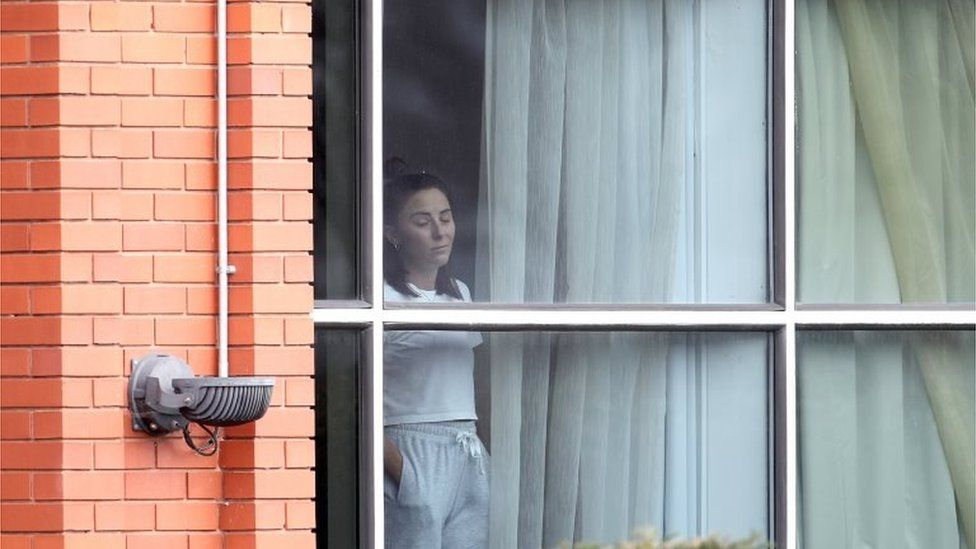
Nearly a third of people arriving in England and Northern Ireland as the coronavirus Delta variant took off may have broken quarantine rules.


More than 300,000 cases were passed to investigators between March and May, according to figures seen by the BBC.

The government was not able to say how many of these were found to have broken the rules or could not be traced.

The Home Office has said it aims to pay home visits to all travellers suspected of not following the rules.

But Labour’s shadow home secretary Nick Thomas-Symonds said the figures obtained by the BBC “confirm our worst fears” about the government’s “lax border policy”.

And he accused the Home Office of “gross negligence”.

It comes as the UK’s four chief medical officers recommend vaccinating healthy children aged between 12 and 15 – as part of a series of measures to control the virus this winter.

It will now be up to ministers whether to accept the recommendation of the four CMOs.

Quarantine arrivals

Earlier this year, the government introduced new rules for people arriving from abroad in an effort to slow the spread of coronavirus and stop new variants arriving in the country.

People arriving from high-risk countries – deemed “red list” – had to quarantine in a hotel.

Those coming from “amber list” – or medium-risk areas – were required to self-isolate for 10 days and provide evidence of negative Covid tests.

From 17 March to 31 May more than a million people arrived in England and Northern Ireland from amber list countries.

Figures for this period obtained under Freedom of Information laws show a total of 301,076 cases were referred to investigators for checks on whether they were self-isolating.

During this time, the highly contagious Delta variant of coronavirus – first detected in India – was spreading rapidly through the country.

Novotel Hotel
image caption Some travellers had to quarantine in hotels, rather than at home

Why were travellers referred to investigators?

Call handlers employed by the Department of Health and Social Care were tasked with contacting arrivals to check they were obeying the self-isolation and testing rules.

Cases where the contact ended the call, refused to co-operate, indicated they would break the quarantine or testing rules, or could not be contacted after three attempts were referred to investigators at the Border Force Criminal Justice Unit and the police.

Officers would then attempt to visit the contact at home to check they were following the rules.

After 26 April, the Home Office hired private contractor Mitie to carry out home visits to international travellers required to isolate, from contacts supplied by NHS Test and Trace.

“We visit over 99% of the cases referred to this service by NHS Test and Trace,” a government spokesman said.

In Wales, the Arriving Travellers Team is responsible for monitoring compliance with the rules – including escalating cases to regional teams to undertake doorstep visits if deemed necessary.

And in Scotland, quarantine measures are monitored by Public Health Scotland through the National Contact Tracing Centre. PHS has the ability to refer to cases to Police Scotland.

‘It was taken on trust’
Henrik Pakula
image caption Henrik Pakula isolated at home after returning from Poland

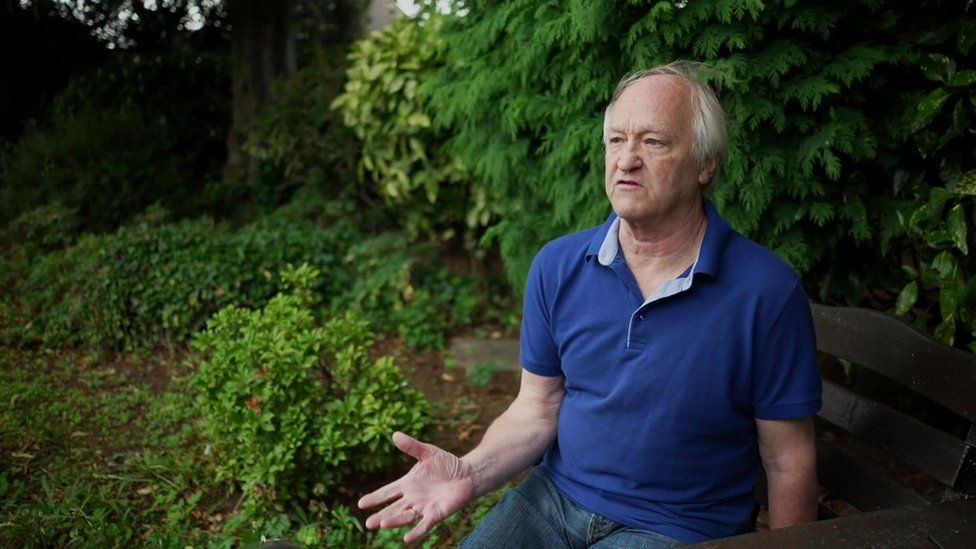
On 1 April, Henrik Pakula began 10 days of isolation at home after returning to England from Poland, where he had been visiting relatives.

“On day one I received a phone call just asking me if I knew the rules on self-isolation, and informing me that there could be random phone calls over the next 10 days just to check I was still at home, but none of those calls materialised,” he said.

“I could have nipped out to the supermarket if I had so desired – no-one would have checked, no-one would have known.

“I got a text message saying these were the rules but there was no contact with anybody at all.

“I knew I had to isolate for 10 days, which I did, but it was taken on trust.”

Lucy Moreton, of the Immigration Services Union, said the quarantine system “very much relied on the honesty of people to do the right thing, rather than any type of meaningful enforcement”.

“There’s limited point in putting rules in place if you don’t enforce them,” she added.

Yvette Cooper, Labour MP and chair of the Home Affairs Committee, said: “We’ve been concerned throughout that there just weren’t proper follow-ups on the checks that were done, and as a result you just had these huge gaps in the home quarantine system and that’s what made it easier for the Delta variant to spread.”

But Conservative MP Huw Merriman, chair of the Transport Committee, said: “There was a balancing act from government… would we have had the resources to check every single person who was quarantining at home? Of course not – so we always knew those risks were in the system”.

………………………………………………………

Somali PM says vote to go ahead despite row


Somali Prime Minister Mohamed Hussein Roble has said that his dispute with President Mohamed Farmajo will not affect plans for long-delayed elections.

“We are committed to holding the elections as planned and other existing matters will not have any effect on the elections,” Mr Roble told a visiting UN delegation led by Deputy Secretary General Amina Mohammed.

The dispute between Mr Roble and Mr Farmajo, sparked by the government’s handling of a missing spy’s case, has raised fears that Somalia’s electoral process could suffer further setbacks.

The Horn of Africa nation is scheduled to hold parliamentary elections between 1 October and 25 November.

On Sunday, the UN deputy chief met Mr Roble and Mr Farmajo and urged them to avoid any moves that “could lead to violence and further delay the elections or undermine its credibility”.

The leaders of Somalia’s South West and Galmudug regional states have launched efforts to defuse the tensions between the president and premier.

……………………………………………………

Barry attempted murder: Man admits stabbing lottery-winner partner


A man has admitted trying to murder his £5.5m lottery-winner partner by stabbing her in the face, arms and stomach.

Stephen Gibbs, 45, was told he faces a lengthy prison sentence for the attack on Emma Brown who won the jackpot four years ago.

He was arrested at Ms Brown’s home in Lakeside, Barry, Vale of Glamorgan, at about 22:00 GMT on 30 January.

Former Cardiff Airport worker Ms Brown, 49, required surgery after the attack.

She has since made a full recovery.

The couple had been together for 11 years and previously owned a home in another part of Barry which they rented out after the lottery win.

Ms Brown has become known for donating to local causes after winning the sum in 2017.

Gibbs was due to go on trial but changed his plea.

Appearing at at Cardiff Crown Court on Monday, he confirmed his name and details before admitting attempting to murder Ms Brown.

‘Question of dangerousness’

Judge Richard Twomlow said he would sentence flooring worker Gibbs after a psychiatric report had been carried out.

He told the defendant: “I need to consider the question of dangerousness.

“You face a very lengthy prison sentence, you must be aware of that.”

Gibbs was remanded in custody and will be sentenced at Merthyr Tydfil Crown Court on 8 October.

………………………………………………………

Celebrating Sofonie Dala’s Achievement

  Celebrating Sofonie Dala’s Achievement Honoring Excellence in Russian Language Studies We proudly celebrate Sofonie Dala for winning t...